
 English
 Español
Automotive Logistics: Meeting Tight Production Deadlines Without Compromise
Automotive Logistics: Meeting Tight Production Deadlines Without Compromise
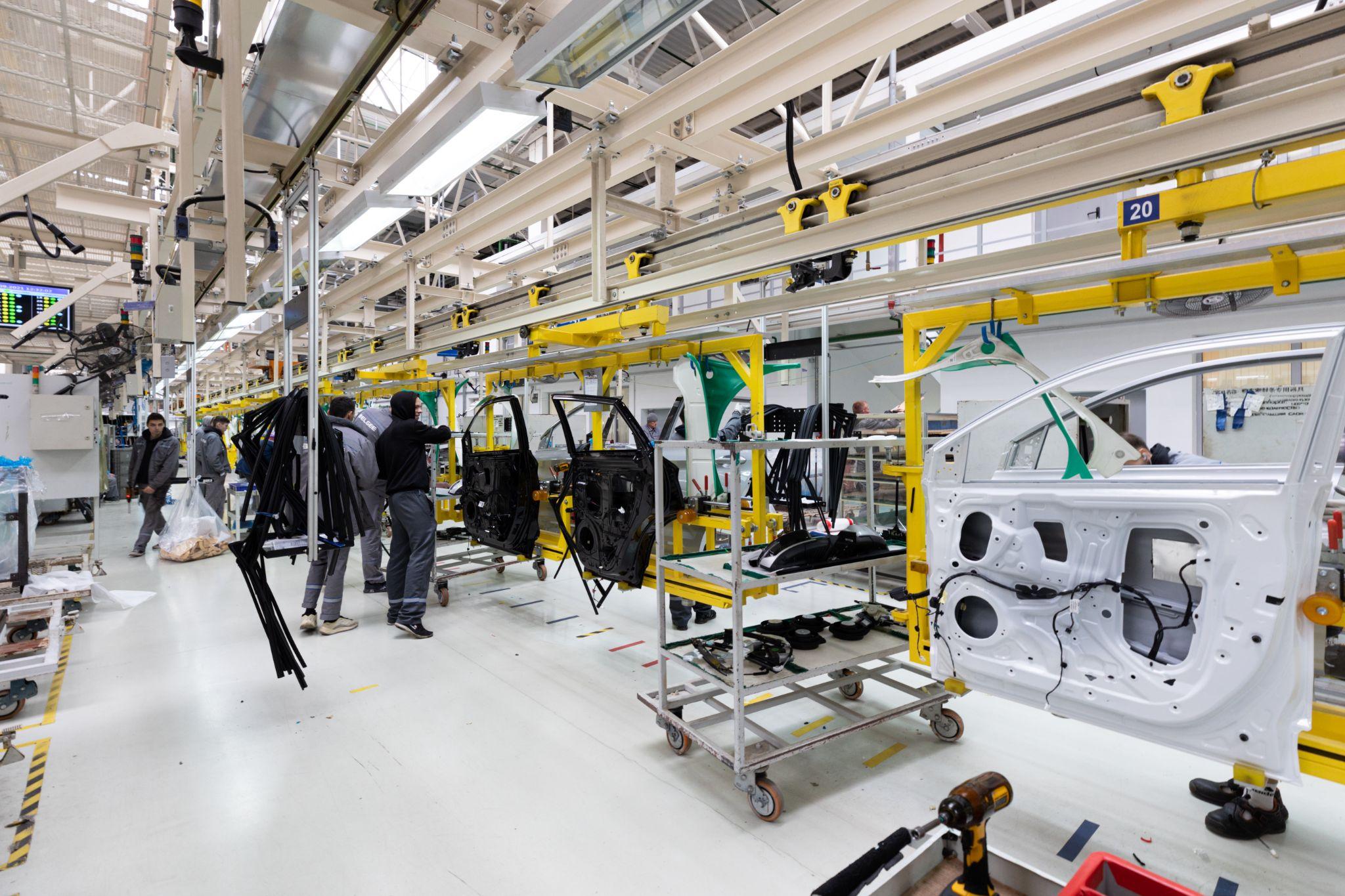
In automotive manufacturing, a shipment arriving a few hours late can have consequences far beyond the cost of transportation. A delayed component can disrupt a tightly coordinated production schedule, leave employees and equipment idle, and create expensive ripple effects throughout the supply chain.
For automotive manufacturers and suppliers, the challenge isn’t simply getting freight from point A to point B. It’s ensuring that materials, components, and equipment arrive precisely when they’re needed, even when suppliers fall behind, transportation capacity tightens, or unexpected disruptions occur. That’s where managed logistics makes a measurable difference.
At Freight Services Inc. (FSI), we’ve seen firsthand how proactive planning, transportation expertise, and coordinated execution help automotive businesses maintain production schedules without sacrificing cost control, compliance, or shipment reliability.
Why Automotive Logistics Leaves Little Room for Error
Automotive supply chains depend on synchronization. Manufacturers often rely on just-in-time (JIT) delivery strategies to reduce inventory carrying costs and keep production moving efficiently. This approach offers significant advantages, but it also creates vulnerabilities.
When a supplier misses a shipping deadline, a truck breaks down, or freight becomes delayed at a border crossing, the consequences can escalate quickly. A single missing component may prevent an entire vehicle from moving through production. And while expedited shipping can sometimes resolve an immediate problem, relying on emergency transportation as a routine solution is neither sustainable nor cost-effective. Successful automotive logistics requires a balance between speed, reliability, flexibility, and cost. Achieving that balance starts well before a shipment is dispatched.
When a Production Line Is at Risk: An FSI Automotive Logistics Success Story
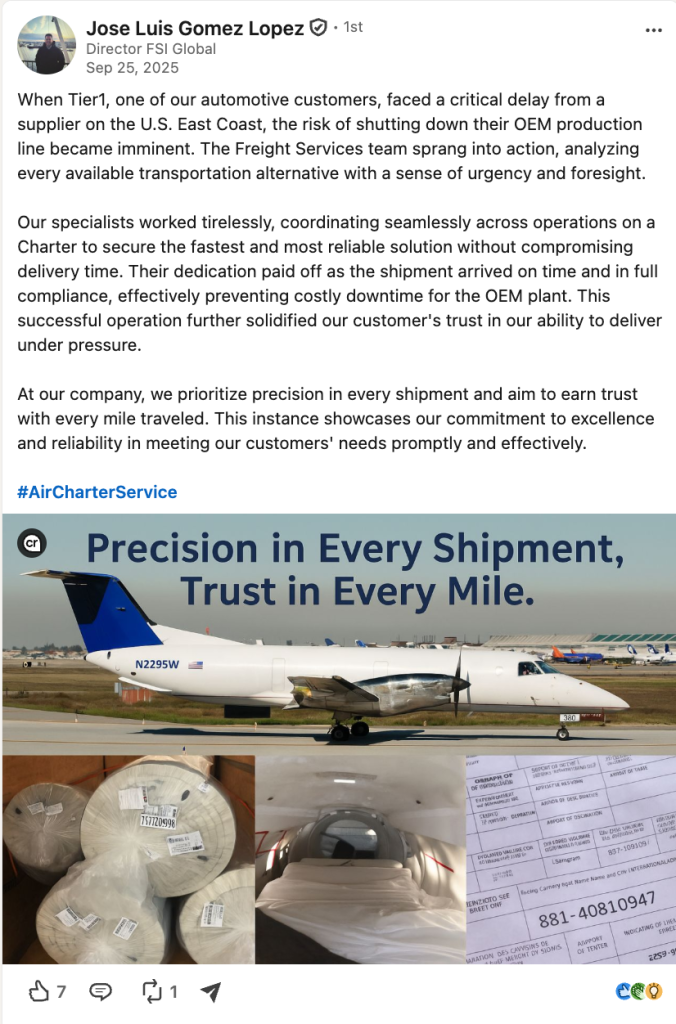
Consider a situation involving one of FSI’s Tier 1 automotive customers. The customer faced a critical supplier delay on the U.S. East Coast. Without immediate intervention, the delayed shipment threatened to shut down production at an original equipment manufacturer (OEM) facility.
So, the stakes were high. An interrupted automotive assembly line can create substantial financial losses, disrupt downstream production schedules, and strain relationships between suppliers and manufacturers. Rather than simply booking the next available truck, the FSI team evaluated transportation alternatives to determine how the shipment could reach its destination within the required timeframe. Working across operations, FSI coordinated a charter solution designed to meet the customer’s urgent delivery requirements. The shipment arrived on time and in full compliance, preventing a costly production shutdown.
The lesson? When production is on the line, transportation decisions must be guided by the customer’s operational priorities, not simply the availability of a particular shipping method.
In situations like this, the value of a managed logistics partner becomes clear. Having experienced professionals who can assess alternatives, coordinate transportation providers, and execute under pressure can make the difference between an expensive interruption and an uninterrupted production schedule.
Why Meeting Production Deadlines Starts Long Before a Shipment Is Dispatched
Emergency transportation is an important capability, but the strongest automotive supply chains aren’t built around reacting to emergencies. They’re built around reducing the likelihood of those emergencies in the first place. A managed logistics strategy examines the entire transportation process, identifying inefficiencies, unnecessary costs, and potential points of failure. This can involve consolidating shipments, improving carrier selection, coordinating inbound and outbound freight, establishing contingency plans, and increasing visibility across transportation networks.
The benefits extend beyond getting freight delivered on time. Better logistics management can also improve inventory availability, reduce administrative work, and help manufacturers use their transportation budgets more effectively.
Real-World Results: FSI’s Supply Chain Optimization Case Study
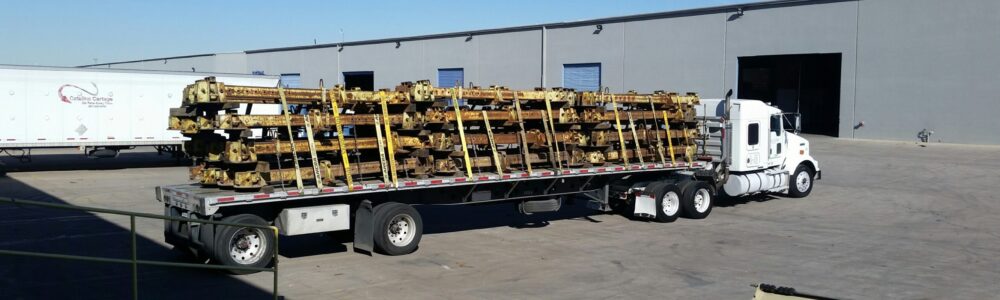
One FSI case study demonstrates how rethinking an existing transportation process can produce substantial improvements. A customer in the trucking industry needed a more efficient way to return towing equipment to manufacturing facilities after completed trucks were delivered to dealerships. The existing process relied on less-than-truckload (LTL) shipments, creating challenges with transportation costs, equipment availability, and shipment coordination.
FSI developed a more structured approach using regional consolidation, coordinated fleet pickups, improved shipment visibility, and centralized documentation. The results included:
- 26.3% reduction in transportation costs
- 40% improvement in inventory turns
- 2.79 days faster equipment returns
- Zero lost-shipment claims
Although this project involved equipment returns rather than emergency parts delivery to an automotive assembly line, the underlying principles are directly relevant to automotive manufacturing.
When transportation is managed as an integrated system rather than a series of individual shipments, businesses gain greater control over costs, equipment availability, and operational timelines. For automotive manufacturers, that kind of coordination can help support more predictable production schedules and reduce the need for last-minute intervention.
Four Ways Managed Logistics Helps Automotive Manufacturers Stay on Schedule
1. Greater Visibility Into Potential Disruptions
A shipment doesn’t have to be officially late to present a problem. Changes in pickup schedules, carrier availability, transit conditions, or customs processing can all indicate that a delivery is at risk. With coordinated transportation management and shipment visibility, logistics teams can identify emerging issues earlier and determine whether adjustments are necessary. For manufacturers operating on tight production schedules, that additional time to respond can be extremely valuable.
2. More Transportation Options When Plans Change
Not every automotive shipment has the same requirements. Some components can move through established truckload or LTL networks. Others may require expedited ground transportation, air freight, or specialized handling. A managed logistics provider can evaluate available modes and carriers based on the shipment’s urgency, destination, handling requirements, and overall cost.
The goal isn’t always to select the fastest transportation method. It’s to select the most appropriate method for meeting the production requirement. FSI’s Tier 1 automotive example illustrates this distinction. The team assessed available alternatives before coordinating a charter solution that met the customer’s deadline.
3. Better Coordination Across Suppliers and Facilities
Automotive manufacturing often involves multiple suppliers, transportation providers, distribution centers, and production facilities. Without centralized coordination, communication gaps can develop between the organizations responsible for moving materials. A managed logistics partner helps connect those moving parts.
This becomes especially important for manufacturers with cross-border supply chains. For example, businesses sourcing components from Mexico must account for more than transportation distance. Customs documentation, regulatory requirements, border procedures, and communication between teams can all affect delivery schedules.
FSI’s established operations in both the United States and Mexico provide customers with local knowledge and coordination across borders, helping them navigate these challenges. For automotive manufacturers, that operational presence can be particularly valuable when production depends on the reliable movement of components between facilities in both countries.
4. Stronger Cost Control Without Sacrificing Reliability
When production deadlines are tight, it’s tempting to prioritize speed at any cost. Sometimes expedited transportation is unavoidable. But consistently paying premium rates to compensate for planning or coordination problems can erode profitability. Managed logistics takes a broader view of transportation spending.
By analyzing shipping patterns, consolidating freight where appropriate, improving routing, and identifying inefficiencies, companies can often reduce unnecessary transportation expenses while maintaining service expectations. FSI’s supply chain optimization case study is a useful example. The customer achieved a substantial reduction in transportation costs while improving equipment turnaround and inventory performance. These outcomes demonstrate why cost control and operational reliability shouldn’t be treated as competing objectives. With the right strategy, they can reinforce one another.
Building Resilience Into Automotive Supply Chains
Automotive supply chains will always face some degree of uncertainty. Supplier delays, transportation disruptions, capacity constraints, and changes in international trade requirements are realities that manufacturers must prepare for. The question is how quickly and effectively an organization can respond when those challenges arise.
Building a more resilient logistics operation means understanding where vulnerabilities exist and establishing practical alternatives before they’re needed. For some manufacturers, that might involve diversifying transportation options or developing backup carrier relationships. For others, it could mean improving cross-border coordination, consolidating freight, or gaining better visibility into inbound shipments. The appropriate strategy depends on the manufacturer’s production requirements, supplier network, and tolerance for disruption. What matters is approaching these decisions proactively rather than waiting for a missed delivery to expose weaknesses in the system.
Automotive Logistics Is About Protecting Production
The true measure of automotive logistics performance isn’t simply how quickly a shipment travels. It’s whether the transportation strategy supports the manufacturer’s broader operational goals. That means keeping production schedules intact, managing transportation expenses, reducing unnecessary inventory disruptions, and responding effectively when unexpected challenges arise.
FSI’s experience demonstrates the value of both approaches: optimizing routine transportation processes to improve efficiency and coordinating urgent solutions when production is at risk. The strongest automotive logistics strategies don’t force manufacturers to choose between reliability and cost control. They help businesses achieve both.
At Freight Services Inc., our managed logistics team works with businesses to develop transportation solutions that reflect their operational priorities, whether that means improving an existing supply chain or resolving a time-sensitive shipping challenge.
Facing tight production deadlines or recurring transportation challenges? Contact FSI to learn how our managed logistics solutions can help keep your supply chain moving.

How Managed Logistics Supports Sustainable Growth in Manufacturing
How Managed Logistics Supports Sustainable Growth in Manufacturing
Growth is exciting for manufacturers, but it also introduces new challenges. More customers, higher production volumes, expanding supplier networks, and increasing transportation demands can quickly expose weaknesses in a supply chain. Processes that worked well for a smaller operation often become difficult to manage as the business expands.
At Freight Services, Inc. (FSI), we’ve seen this transition firsthand: as manufacturing networks grow, transportation stops being a series of individual shipments and becomes an operational system that has to be actively managed.
Many manufacturers initially respond by adding more carriers, hiring additional staff, or investing in new software. While those steps may help temporarily, they often fail to address the underlying issue: logistics has become too complex to manage efficiently without a coordinated strategy. That is where managed logistics can make a real difference.
Rather than simply arranging transportation, a managed logistics partner oversees the larger freight operation, helping manufacturers improve visibility, reduce costs, minimize disruptions, and build a supply chain capable of supporting long-term growth.
Growth Creates Complexity
As manufacturers scale, logistics becomes significantly more complicated. A growing company may suddenly find itself coordinating shipments from multiple suppliers, managing inbound raw materials alongside outbound finished products, scheduling appointments at distribution centers, and balancing domestic and international transportation. At the same time, customer expectations continue to rise, with greater demands for speed, communication, and reliability. Without a centralized logistics strategy, these moving parts often become disconnected.
Common challenges include higher transportation costs, inconsistent carrier performance, limited shipment visibility, production delays caused by late deliveries, increased administrative workload, and difficulty responding to unexpected disruptions. Instead of supporting growth, logistics can begin slowing it down.
Managed Logistics Goes Beyond Freight
Many businesses think of logistics as simply booking trucks or arranging transportation. In reality, managed logistics takes a much broader approach.
A traditional freight broker or 3PL may help a business arrange transportation, access carriers, manage warehousing, or handle other specific logistics functions. A 4PL takes a more comprehensive approach, helping manage and coordinate the broader transportation network, including multiple carriers, providers, technologies, and processes.
As a true 4PL organization, FSI can act as an extension of a manufacturer’s operations rather than simply providing transportation for individual shipments. This allows logistics decisions to be made with the larger supply chain and the company’s business goals in mind.
Managed logistics can include carrier selection and performance management, route optimization, shipment tracking, capacity planning, documentation management, international shipping coordination, freight cost analysis, and risk management. The goal is not simply to react when something goes wrong. It is to create a transportation system that is actively managed to improve performance and prevent avoidable problems.
Better Visibility Leads to Better Decisions
One of the biggest obstacles manufacturers face is limited visibility across their supply chain. When shipments are managed by multiple carriers using different systems, it becomes difficult to know where products are, whether deliveries are on schedule, or how delays may affect production. Managed logistics brings this information together into a more coordinated process.
With better supply chain visibility, manufacturers can make more accurate production decisions, respond faster to delays, improve communication with customers, reduce inventory uncertainty, and identify recurring bottlenecks before they become costly problems. Visibility is no longer simply a convenience. It has become an essential part of effective manufacturing operations.
Lower Costs Without Sacrificing Service
Sustainable growth isn’t just about increasing revenue. It also requires controlling operational costs. Managed logistics helps manufacturers reduce transportation expenses by continuously evaluating carrier performance, shipment consolidation opportunities, routing efficiency, and freight spend. Instead of making shipping decisions one load at a time, logistics experts can analyze the entire transportation network to uncover opportunities for improvement.
Those efficiencies can lead to lower freight costs, fewer expedited shipments, better carrier utilization, reduced detention and accessorial charges, and improved planning across departments. Small improvements across hundreds or thousands of shipments each year can have a significant financial impact.
Building Resilience Into the Supply Chain
Supply chain disruptions are a normal part of doing business. Weather events, labor shortages, capacity fluctuations, port congestion, changing tariffs, and global events can all affect transportation. Manufacturers that rely on reactive logistics may struggle to adapt quickly.
A managed logistics strategy can help establish contingency plans before disruptions occur. Alternative carriers, routing options, proactive communication, and greater visibility give manufacturers more options when conditions change. The result is a supply chain that is more flexible and better equipped to support continued growth.
Managed Logistics in Action
The impact becomes particularly clear when you look at the numbers. FSI worked with a leading trucking equipment manufacturer that was dealing with an inefficient and expensive process for returning towing equipment to its manufacturing facilities after deliveries. Multiple less-than-truckload (LTL) carriers resulted in high transportation costs, missed pickups, and an increasingly complicated administrative process.
FSI redesigned the operation around a regional consolidation network, combining local facilities and regional warehouses across North America with FSI’s asset-based fleet and trusted private carriers. The solution also introduced real-time shipment tracking, centralized communication, and support for documentation and customs requirements.
THE RESULTS
- 26.3% reduction in transportation costs
- 40% improvement in inventory turns
- 2.79 days faster returns
- Zero lost-shipment claims
The manufacturer also went from managing multiple carriers and invoices to having a single point of contact and one consolidated invoice.
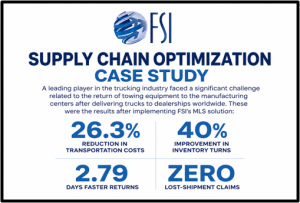
Those improvements demonstrate the larger value of supply chain optimization. The goal wasn’t simply to find a cheaper way to move an individual shipment. It was to improve the transportation system as a whole, creating greater visibility, efficiency, and scalability.
Choosing a Partner Instead of a Provider
The most successful manufacturers don’t simply look for a company that can move freight. They look for a logistics partner that understands how transportation affects production schedules, inventory management, customer satisfaction, and long-term business performance. That’s an important distinction as a business grows.
Individual carriers and freight brokers can remain valuable parts of a transportation network. But when manufacturers reach a point where they are coordinating multiple modes, carriers, facilities, suppliers, and destinations, managing those pieces strategically becomes increasingly important.
A managed logistics or 4PL approach provides oversight across those moving parts, helping manufacturers see the bigger picture and make decisions based on the performance of the entire supply chain rather than one shipment at a time.
For manufacturers focused on sustainable growth, that can mean lower costs, greater visibility, less administrative burden, and a supply chain that is better prepared to scale alongside the business.
At FSI, our role is to help manufacturers build and manage transportation strategies that support where their businesses are today and where they’re headed next.
Ready to fortify your supply chain? Contact us today to see how FSI can help your business grow sustainably.