
 English
 Español
What U.S.–Mexico Trade Growth Means for Your Business
What U.S.–Mexico Trade Growth Means for Your Business
The trade relationship between the United States and Mexico continues to create new opportunities for manufacturers, distributors, and other businesses throughout North America. As companies rethink where products are manufactured, how components are sourced, and how quickly goods can reach customers, Mexico has become an increasingly important part of the conversation.
At Freight Services, Inc. (FSI), we aren’t observing that shift from the sidelines. We operate on both sides of the U.S.–Mexico border, giving our team firsthand experience with the operational realities of cross-border business and logistics. That matters because moving manufacturing closer to home can shorten supply chains, but it doesn’t necessarily make them simpler. The challenges change. Businesses need to think differently about transportation, customs, documentation, carrier coordination, communication, and what happens at the border itself.
U.S.–Mexico Trade Is Already Enormous and Still Growing
The numbers illustrate just how significant this relationship has become.According to the Office of the United States Trade Representative, U.S.–Mexico goods trade reached approximately $871.6 billion in 2025, including $337.3 billion in U.S. exports and $534.3 billion in imports. Imports from Mexico increased 6.2% compared with 2024. When services are included, total trade between the two countries reached approximately $964.1 billion in 2025, an increase of 3.7% from the previous year.
And that momentum has continued. U.S. Census Bureau data shows that through June 2026, the two countries had already exchanged approximately $493.7 billion in goods, including $195.6 billion in U.S. exports and $298.2 billion in imports. In other words, this isn’t a future trend. Cross-border trade is already a major part of the North American economy, and businesses need supply chains capable of supporting it.
Nearshoring Changes the Logistics Equation
One factor driving greater interest in Mexico is nearshoring, as companies move manufacturing and sourcing closer to U.S. customers. Mexico offers geographic proximity, established manufacturing capabilities, and access to the U.S. market through the United States-Mexico-Canada Agreement (USMCA). Industries including automotive, aerospace, medical devices, electronics, and industrial equipment already have substantial manufacturing activity in Mexico. But the logistics strategy required for nearshoring looks different from a traditional overseas supply chain.
Consider an Arizona manufacturer sourcing components from Sonora. Instead of waiting weeks for a container to cross the Pacific and move through a U.S. port, freight may be only days away. That proximity creates opportunities for shorter lead times, lower inventory requirements, and faster responses to changes in production. But it also makes day-to-day execution especially important. Border timing, customs coordination, carrier capacity, documentation, pickup schedules, and communication between teams can directly affect whether those shorter lead times actually materialize. Nearshoring doesn’t eliminate logistics complexity. It changes where that complexity occurs.
Cross-Border Freight Is a Chain, Not a Single Shipment
It is easy to picture cross-border transportation as a truck picking up freight in Mexico, driving through a checkpoint, and continuing to its U.S. destination. In practice, there are several coordinated steps involved. A typical shipment might include:
Origin pickup → Mexico linehaul → customs and documentation → border crossing → carrier or driver handoff when applicable → U.S. linehaul → final delivery
Visibility and communication need to continue throughout that entire process. Each step depends on the one before it. Documentation issues can delay customs clearance. A delayed linehaul can affect a planned border crossing. A missed handoff can affect the U.S. leg of the shipment. Ultimately, a transportation delay can become a production delay for the customer waiting on those materials. That’s why successful cross-border logistics requires more than finding a carrier with available capacity. Someone needs to understand and coordinate the complete movement from origin to destination.
What FSI Learned by Building Operations in Mexico
Freight Services, Inc. opened its first international office in Hermosillo, Mexico, in 2022. The move gave FSI firsthand experience navigating the operational, financial, regulatory, and communication challenges companies encounter when doing business across the U.S.–Mexico border. That experience extends well beyond freight.
Operating in Mexico means understanding how business actually gets done locally. It requires bilingual communication between customers, carriers, vendors, and internal teams. It means building local relationships and understanding differences in documentation, regulations, payment processes, currency, taxation, and business practices. It also requires close coordination between teams on both sides of the border.
For FSI, establishing operations in Mexico provided an important perspective: a cross-border supply chain cannot be managed effectively as two completely separate domestic transportation networks. The U.S. and Mexico sides have to work together. When a customer has a question, encounters a documentation problem, needs to adjust a shipment, or faces an unexpected delay, communication needs to cross the border just as effectively as the freight does.
Having people, relationships, and infrastructure in Mexico gives FSI a practical understanding of those challenges. We’re not simply arranging Mexico freight from a desk in the United States. We’ve built experience on both sides of the border.
What Growing Trade Means for Your Business
For companies considering nearshoring, expanding Mexican manufacturing relationships, or simply moving more freight between the two countries, the opportunity is significant. Shorter supply chains can improve responsiveness. Greater geographic diversification can reduce dependence on overseas transportation. Proximity to manufacturing operations can make it easier to respond when customer demand or production requirements change. But those advantages depend on execution.
A supplier that is geographically closer isn’t necessarily more useful if freight repeatedly gets held up at the border. Faster transit doesn’t help if poor visibility leaves production teams unsure when components will arrive. And transportation savings can disappear quickly when missed pickups, documentation problems, or emergency shipments become routine. The logistics strategy has to evolve alongside the sourcing strategy.
Building a Cross-Border Supply Chain for Long-Term Growth
As U.S.–Mexico trade continues to expand, businesses have an opportunity to build supply chains that are closer, faster, and potentially more resilient. Doing so requires understanding that cross-border logistics isn’t simply domestic transportation with a customs stop in the middle. It is a coordinated system involving people, carriers, documentation, regulations, technology, communication, and relationships on both sides of an international border. That’s where experience matters.
FSI’s presence in both the United States and Mexico allows our teams to approach cross-border logistics with firsthand knowledge of how those systems interact. Whether a business is already manufacturing in Mexico, expanding its supplier network, or exploring nearshoring for the first time, the right logistics infrastructure can help turn geographic proximity into a meaningful supply chain advantage.
As U.S.–Mexico trade approaches the trillion-dollar mark, the question for many businesses is no longer whether Mexico will play a role in North American supply chains. It’s how effectively they are prepared to operate across the border.
Ready to turn your logistics into a competitive advantage? Contact us today to learn how FSI can support your business.
How Managed Logistics Supports Sustainable Growth in Manufacturing
How Managed Logistics Supports Sustainable Growth in Manufacturing
Growth is exciting for manufacturers, but it also introduces new challenges. More customers, higher production volumes, expanding supplier networks, and increasing transportation demands can quickly expose weaknesses in a supply chain. Processes that worked well for a smaller operation often become difficult to manage as the business expands.
At Freight Services, Inc. (FSI), we’ve seen this transition firsthand: as manufacturing networks grow, transportation stops being a series of individual shipments and becomes an operational system that has to be actively managed.
Many manufacturers initially respond by adding more carriers, hiring additional staff, or investing in new software. While those steps may help temporarily, they often fail to address the underlying issue: logistics has become too complex to manage efficiently without a coordinated strategy. That is where managed logistics can make a real difference.
Rather than simply arranging transportation, a managed logistics partner oversees the larger freight operation, helping manufacturers improve visibility, reduce costs, minimize disruptions, and build a supply chain capable of supporting long-term growth.
Growth Creates Complexity
As manufacturers scale, logistics becomes significantly more complicated. A growing company may suddenly find itself coordinating shipments from multiple suppliers, managing inbound raw materials alongside outbound finished products, scheduling appointments at distribution centers, and balancing domestic and international transportation. At the same time, customer expectations continue to rise, with greater demands for speed, communication, and reliability. Without a centralized logistics strategy, these moving parts often become disconnected.
Common challenges include higher transportation costs, inconsistent carrier performance, limited shipment visibility, production delays caused by late deliveries, increased administrative workload, and difficulty responding to unexpected disruptions. Instead of supporting growth, logistics can begin slowing it down.
Managed Logistics Goes Beyond Freight
Many businesses think of logistics as simply booking trucks or arranging transportation. In reality, managed logistics takes a much broader approach.
A traditional freight broker or 3PL may help a business arrange transportation, access carriers, manage warehousing, or handle other specific logistics functions. A 4PL takes a more comprehensive approach, helping manage and coordinate the broader transportation network, including multiple carriers, providers, technologies, and processes.
As a true 4PL organization, FSI can act as an extension of a manufacturer’s operations rather than simply providing transportation for individual shipments. This allows logistics decisions to be made with the larger supply chain and the company’s business goals in mind.
Managed logistics can include carrier selection and performance management, route optimization, shipment tracking, capacity planning, documentation management, international shipping coordination, freight cost analysis, and risk management. The goal is not simply to react when something goes wrong. It is to create a transportation system that is actively managed to improve performance and prevent avoidable problems.
Better Visibility Leads to Better Decisions
One of the biggest obstacles manufacturers face is limited visibility across their supply chain. When shipments are managed by multiple carriers using different systems, it becomes difficult to know where products are, whether deliveries are on schedule, or how delays may affect production. Managed logistics brings this information together into a more coordinated process.
With better supply chain visibility, manufacturers can make more accurate production decisions, respond faster to delays, improve communication with customers, reduce inventory uncertainty, and identify recurring bottlenecks before they become costly problems. Visibility is no longer simply a convenience. It has become an essential part of effective manufacturing operations.
Lower Costs Without Sacrificing Service
Sustainable growth isn’t just about increasing revenue. It also requires controlling operational costs. Managed logistics helps manufacturers reduce transportation expenses by continuously evaluating carrier performance, shipment consolidation opportunities, routing efficiency, and freight spend. Instead of making shipping decisions one load at a time, logistics experts can analyze the entire transportation network to uncover opportunities for improvement.
Those efficiencies can lead to lower freight costs, fewer expedited shipments, better carrier utilization, reduced detention and accessorial charges, and improved planning across departments. Small improvements across hundreds or thousands of shipments each year can have a significant financial impact.
Building Resilience Into the Supply Chain
Supply chain disruptions are a normal part of doing business. Weather events, labor shortages, capacity fluctuations, port congestion, changing tariffs, and global events can all affect transportation. Manufacturers that rely on reactive logistics may struggle to adapt quickly.
A managed logistics strategy can help establish contingency plans before disruptions occur. Alternative carriers, routing options, proactive communication, and greater visibility give manufacturers more options when conditions change. The result is a supply chain that is more flexible and better equipped to support continued growth.
Managed Logistics in Action
The impact becomes particularly clear when you look at the numbers. FSI worked with a leading trucking equipment manufacturer that was dealing with an inefficient and expensive process for returning towing equipment to its manufacturing facilities after deliveries. Multiple less-than-truckload (LTL) carriers resulted in high transportation costs, missed pickups, and an increasingly complicated administrative process.
FSI redesigned the operation around a regional consolidation network, combining local facilities and regional warehouses across North America with FSI’s asset-based fleet and trusted private carriers. The solution also introduced real-time shipment tracking, centralized communication, and support for documentation and customs requirements.
THE RESULTS
- 26.3% reduction in transportation costs
- 40% improvement in inventory turns
- 2.79 days faster returns
- Zero lost-shipment claims
The manufacturer also went from managing multiple carriers and invoices to having a single point of contact and one consolidated invoice.
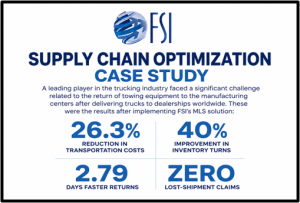
Those improvements demonstrate the larger value of supply chain optimization. The goal wasn’t simply to find a cheaper way to move an individual shipment. It was to improve the transportation system as a whole, creating greater visibility, efficiency, and scalability.
Choosing a Partner Instead of a Provider
The most successful manufacturers don’t simply look for a company that can move freight. They look for a logistics partner that understands how transportation affects production schedules, inventory management, customer satisfaction, and long-term business performance. That’s an important distinction as a business grows.
Individual carriers and freight brokers can remain valuable parts of a transportation network. But when manufacturers reach a point where they are coordinating multiple modes, carriers, facilities, suppliers, and destinations, managing those pieces strategically becomes increasingly important.
A managed logistics or 4PL approach provides oversight across those moving parts, helping manufacturers see the bigger picture and make decisions based on the performance of the entire supply chain rather than one shipment at a time.
For manufacturers focused on sustainable growth, that can mean lower costs, greater visibility, less administrative burden, and a supply chain that is better prepared to scale alongside the business.
At FSI, our role is to help manufacturers build and manage transportation strategies that support where their businesses are today and where they’re headed next.
Ready to fortify your supply chain? Contact us today to see how FSI can help your business grow sustainably.

How the Right Freight Partner Keeps Your Supply Chain Moving Smoothly
How the Right Freight Partner Keeps Your Supply Chain Moving Smoothly
A smooth-running supply chain can feel invisible when everything is working the way it should. Products arrive on time, inventory stays where it needs to be, production schedules stay intact, and customers rarely think twice about delivery timelines.
But when something goes wrong, the impact can be immediate. A delayed shipment can slow production. Missing inventory can disrupt schedules. Poor communication or lack of shipment visibility can quickly create frustration across operations, customer service, and leadership teams.
For manufacturers, agricultural operations, medical suppliers, distributors, and industrial businesses, supply chain disruptions are more than inconvenient. They can be expensive. That is why choosing the right freight partner matters.
A strong logistics partner does far more than move freight from one location to another. They help reduce risk, improve visibility, solve problems before they escalate, and keep supply chains operating smoothly even when conditions change.
Freight Is Only One Part of the Equation
Many companies think of freight in simple terms: book transportation, move products, confirm delivery. In reality, successful logistics management is much more complex. Every shipment is influenced by factors such as:
- Carrier availability
- Weather disruptions
- Customs requirements for international shipments
- Capacity constraints
- Documentation accuracy
- Tariffs and trade changes
- Warehouse timing and appointments
- Production schedules and inventory planning
The right freight partner helps coordinate these moving pieces so businesses are not left reacting to problems after they happen. Instead of simply responding to issues, they focus on preventing disruptions in the first place. That shift—from transportation provider to logistics partner—is often what makes the biggest difference.
Visibility Matters More Than Ever
One of the biggest challenges companies face today is visibility. It is difficult to make informed decisions when teams do not know exactly where shipments are, when products will arrive, or what delays may be developing in real time. Without visibility, operations often fall back on rough estimates and reactive decision-making. A strong freight partner provides tracking, communication, reporting, and data that allow businesses to make smarter operational decisions.
For example, one international industrial shipper experiencing rapid growth found that managing its increasingly complex global transportation network became difficult as shipment volume expanded. The issue was not simply transportation capacity. It was visibility. When FSI helped them find solutions to real-time tracking and shipment data, they gained more control over their operations and were able to provide customers with more accurate information.
While every business faces different challenges, the lesson is universal: supply chain visibility reduces uncertainty.
Problem-Solving Is Just as Important as Transportation
Even the best supply chains experience disruptions. A truck breaks down. Severe weather changes transit plans. Documentation errors create delays. Capacity tightens unexpectedly. The difference between a smooth operation and a costly disruption often comes down to how quickly problems are identified and solved.
A strong freight partner brings experience, contingency planning, and communication strategies that help reduce downtime and keep freight moving. Sometimes, solving a logistics challenge means rethinking the process entirely.
In one case, a manufacturer shipping specialty surgical tables struggled with recurring damage during transportation. Rather than treating the issue as unavoidable, FSI evaluated handling practices, carrier selection, packaging, and training opportunities to reduce shipping issues and improve shipment outcomes.
The takeaway is not simply that freight arrived in better condition. It is that proactive logistics management helped reduce risk. That is what strong supply chain partnerships should do.
Risk Reduction Is the Real Goal
Businesses often evaluate freight providers based on cost alone. But focusing only on price can overlook larger operational risks. What happens when a delayed shipment halts production? What happens when poor communication leaves customers waiting for answers? What happens when limited visibility makes planning difficult? The right freight partner helps businesses think beyond transportation costs and consider the bigger picture. Reliable logistics can help reduce:
- Costly production delays
- Inventory disruptions
- Damage claims and shipping issues
- Communication gaps
- Missed deadlines
- Unnecessary stress across teams
In many cases, a stronger logistics strategy saves money by preventing expensive problems before they occur.
Choosing the Right Freight Partner
Not every logistics provider offers the same level of support. When evaluating a freight partner, businesses should look for more than shipping capacity. Some important questions to ask include:
- Do they provide visibility and tracking?
- Can they support domestic and international shipping needs?
- Do they understand industry-specific challenges?
- How do they handle disruptions or delays?
- Can they scale as your business grows?
- Do they act proactively or reactively?
The best logistics relationships feel collaborative. Instead of simply moving freight, the right partner becomes an extension of your operations team—helping reduce risk, solve problems, and create stability in an increasingly complex supply chain environment.
A Supply Chain Partner, Not Just a Transportation Provider
At the end of the day, smooth supply chains are rarely accidental. They are built through planning, communication, visibility, and proactive problem-solving. The right freight partner helps businesses stay agile, navigate disruptions, and keep products moving without unnecessary friction.
Because logistics is not just about transportation. It is about helping your business move forward with confidence.
Ready to up your shipping game with a trusted logistics partner, FSI is here to help! Contact us today to discuss your business needs.
What Does It Mean to Be NVOCC Certified?
If your business relies on international shipping, you’ve probably come across the term NVOCC. So, what does it actually mean? And why does it matter?
NVOCC stands for Non-Vessel Operating Common Carrier. While the name sounds technical, the concept is simple: an NVOCC is a company that manages ocean freight transportation without owning the ships themselves.
Instead of operating vessels, an NVOCC works as a transportation partner that books cargo space with ocean carriers, coordinates international shipments, manages documentation, and helps businesses move freight efficiently across global supply chains.
For companies shipping internationally, working with an NVOCC-certified provider adds an important layer of expertise, compliance, and reliability.
What Does an NVOCC Do?
An NVOCC acts as the bridge between shippers and ocean carriers.
They consolidate shipments, negotiate freight rates, coordinate container movement, issue bills of lading, and help manage the many details involved in international ocean freight.
This includes:
- Booking cargo space with shipping lines
- Managing import and export documentation
- Coordinating customs requirements
- Handling port logistics and container movement
- Providing shipment visibility and communication
- Helping resolve delays, disruptions, or compliance issues
In short, they simplify a very complicated process.
For businesses that don’t have an in-house international shipping department, an experienced NVOCC becomes a critical logistics partner.
What Does “Certified” Mean?
Being NVOCC certified means a company meets the legal and regulatory requirements to operate as a Non-Vessel Operating Common Carrier.
In the United States, this includes registration and compliance through the Federal Maritime Commission (FMC), along with financial responsibility requirements such as bonds and licensing standards.
This certification is important because it ensures the company is operating within federal regulations and has the authority to handle international ocean freight properly.
It also demonstrates accountability.
International shipping involves major financial, operational, and compliance risks. Businesses need confidence that their logistics provider understands the rules, follows the correct procedures, and can protect shipments from unnecessary delays or costly mistakes.
Why NVOCC Certification Matters for Customers
When choosing a logistics partner, certification matters because trust matters.
Ocean freight is rarely simple. Delays at ports, customs requirements, documentation errors, and shifting international regulations can quickly create problems if shipments are not managed correctly.
An NVOCC-certified provider helps reduce that risk.
It means your logistics partner can:
- Manage ocean freight legally and professionally
- Provide accurate documentation and bills of lading
- Navigate customs and compliance requirements
- Coordinate cross-border transportation more effectively
- Offer stronger visibility and shipment control
- Help prevent avoidable delays and added costs
For customers, that translates to smoother operations, fewer surprises, and better protection for your supply chain.
NVOCC vs. Freight Forwarder
These two terms are often used together, but they are not exactly the same. A freight forwarder helps arrange transportation and coordinate shipping services across multiple modes, including air, ocean, and ground. An NVOCC focuses specifically on ocean freight and operates as a carrier to the shipper, even though they do not own the vessel.
In many cases, a logistics provider may offer both services, giving customers a more complete international shipping solution. The key difference is that an NVOCC can issue its own bill of lading and assumes greater responsibility for the cargo movement. That added responsibility is one reason certification matters so much.
Why It Matters at Freight Services Inc.
At Freight Services Inc., global logistics means more than moving containers from one port to another. It means helping customers navigate international trade with confidence. As an NVOCC-certified provider, FSI supports businesses with ocean freight coordination, cross-border expertise, customs support, documentation management, and the strategic visibility needed to keep freight moving efficiently.
Our team understands that every shipment affects production schedules, customer relationships, and business profitability. That’s why compliance, communication, and proactive problem-solving are built into every move. Because in global logistics, experience matters—but certified expertise matters even more.
Work with FSI
NVOCC certification is not just an industry label. It represents trust, compliance, and the ability to manage international ocean freight the right way. For businesses shipping globally, choosing the right logistics partner can mean the difference between smooth operations and costly disruptions.
Working with an NVOCC-certified provider helps protect your freight, your timelines, and your bottom line. And when global shipping gets complicated, having the right partner makes all the difference. Contact us today if you’re ready to take your shipping operations to the next level.