
 English
'/%3E%3Cpath%20fill='%2330c2dc'%20d='M493%20379c-14-6%2010-16%2014-16-8-1-21%203-27%203l-57-3c-7-1-12-10-10-10-3%203-37-9-27%200l9%2014c15-3%2030%208%2013%2014%203%200%2057-4%2085-2'/%3E%3Cpath%20fill='%23f9aa51'%20d='M475%20366v13q-1%207-7%207h-35q-6-1-7-7v-13q0-6%207-7h35q7%201%207%207'/%3E%3Cpath%20fill='%230c8489'%20d='M388%20335c-11%205-28-12-25-24%203-13%2028-2%2029%2014%207-2%2020%202%2025%207%209-11%2038-3%2041%2010%2011-13%2028-9%2034-3%2013-10%2033-4%2030%207-3%2012-29%2015-37%206-1%201-20%200-22%2016h-11c-3-4-2-14-1-15-11%204-29-3-34-10-7%204-25-1-29-8'/%3E%3Cpath%20fill='%23fcca3d'%20d='m419%20304-3%203c-7-4-11%208-19-2-2-3-3-10%205-16%205-3%2018-5%2019%200%203%206%207%206%204%209l4%203v9zm56%2031c-15%204-16%209-15%2012q-7-6-1-10c-9-8-10%206-8-6%201-8%2024%205%2018-15h9q-1%2015%2017%2019c0%2024%202-3-6%205-2%200-5-6-14-5'/%3E%3Cpath%20fill='%238f4620'%20d='M418%20268c-4-24%2020-46%202-44-16%201-18-2-18-2-6-7%2010-11%209-20q2%2011%205-4c2%206%204%208%205-3%205%207%2017%205%2025%2010q-3-6-10-11c-12-11%2012-9%2012-9%2033-11%2044%2012%2061%2012-17%203%2013-2%2038%2058-18-11%2012-1-7%2067%200%200-45-57-36-39-10-5-20-18-20-18-11%203-2%204-1%2020%200%200%2043%2030%2045%2036%201%206-10%204-25%207-16%202-23-20-22-10s-16%205-16%205-19-29-19-9c-39-3-20-15-20-15s10%202%208-2c-2-3-12-4-16-29m-7-66'/%3E%3Cpath%20fill='%23f9c83a'%20d='M407%20220c10%203%2015-3%2016%204%204%204-22%209-19%2014-7%203-18-10-5-16%201-5%206-3%206-3l6-8q3%207-4%209'/%3E%3Cpath%20fill='%23a8ac71'%20d='M403%20309c-15%201-19%205-23-16-18-16-8-25-7-28%201-8-12-11-15-10-1-8%2022-1%2021%209-1%209-7%2011%206%2024%205%204%203%2014%2011%2011-1%204%203%2010%207%2010m6-18c10-8-24%202-26-24-1-15%2027-22%2023-34l-5-3q1-4%207-3c19%2015-11%2027-14%2038-4%2024%2031-5%2025%2029l-3%205q-7-4-7-8m-11-54c-25%206-23-35-7-35%201%2020-15%2015%205%2015-8%200-13%2011-3%2012q1%206%205%208'/%3E%3C/svg%3E) Español
Español
What U.S.–Mexico Trade Growth Means for Your Business
What U.S.–Mexico Trade Growth Means for Your Business
The trade relationship between the United States and Mexico continues to create new opportunities for manufacturers, distributors, and other businesses throughout North America. As companies rethink where products are manufactured, how components are sourced, and how quickly goods can reach customers, Mexico has become an increasingly important part of the conversation.
At Freight Services, Inc. (FSI), we aren’t observing that shift from the sidelines. We operate on both sides of the U.S.–Mexico border, giving our team firsthand experience with the operational realities of cross-border business and logistics. That matters because moving manufacturing closer to home can shorten supply chains, but it doesn’t necessarily make them simpler. The challenges change. Businesses need to think differently about transportation, customs, documentation, carrier coordination, communication, and what happens at the border itself.
U.S.–Mexico Trade Is Already Enormous and Still Growing
The numbers illustrate just how significant this relationship has become.According to the Office of the United States Trade Representative, U.S.–Mexico goods trade reached approximately $871.6 billion in 2025, including $337.3 billion in U.S. exports and $534.3 billion in imports. Imports from Mexico increased 6.2% compared with 2024. When services are included, total trade between the two countries reached approximately $964.1 billion in 2025, an increase of 3.7% from the previous year.
And that momentum has continued. U.S. Census Bureau data shows that through June 2026, the two countries had already exchanged approximately $493.7 billion in goods, including $195.6 billion in U.S. exports and $298.2 billion in imports. In other words, this isn’t a future trend. Cross-border trade is already a major part of the North American economy, and businesses need supply chains capable of supporting it.
Nearshoring Changes the Logistics Equation
One factor driving greater interest in Mexico is nearshoring, as companies move manufacturing and sourcing closer to U.S. customers. Mexico offers geographic proximity, established manufacturing capabilities, and access to the U.S. market through the United States-Mexico-Canada Agreement (USMCA). Industries including automotive, aerospace, medical devices, electronics, and industrial equipment already have substantial manufacturing activity in Mexico. But the logistics strategy required for nearshoring looks different from a traditional overseas supply chain.
Consider an Arizona manufacturer sourcing components from Sonora. Instead of waiting weeks for a container to cross the Pacific and move through a U.S. port, freight may be only days away. That proximity creates opportunities for shorter lead times, lower inventory requirements, and faster responses to changes in production. But it also makes day-to-day execution especially important. Border timing, customs coordination, carrier capacity, documentation, pickup schedules, and communication between teams can directly affect whether those shorter lead times actually materialize. Nearshoring doesn’t eliminate logistics complexity. It changes where that complexity occurs.
Cross-Border Freight Is a Chain, Not a Single Shipment
It is easy to picture cross-border transportation as a truck picking up freight in Mexico, driving through a checkpoint, and continuing to its U.S. destination. In practice, there are several coordinated steps involved. A typical shipment might include:
Origin pickup → Mexico linehaul → customs and documentation → border crossing → carrier or driver handoff when applicable → U.S. linehaul → final delivery
Visibility and communication need to continue throughout that entire process. Each step depends on the one before it. Documentation issues can delay customs clearance. A delayed linehaul can affect a planned border crossing. A missed handoff can affect the U.S. leg of the shipment. Ultimately, a transportation delay can become a production delay for the customer waiting on those materials. That’s why successful cross-border logistics requires more than finding a carrier with available capacity. Someone needs to understand and coordinate the complete movement from origin to destination.
What FSI Learned by Building Operations in Mexico
Freight Services, Inc. opened its first international office in Hermosillo, Mexico, in 2022. The move gave FSI firsthand experience navigating the operational, financial, regulatory, and communication challenges companies encounter when doing business across the U.S.–Mexico border. That experience extends well beyond freight.
Operating in Mexico means understanding how business actually gets done locally. It requires bilingual communication between customers, carriers, vendors, and internal teams. It means building local relationships and understanding differences in documentation, regulations, payment processes, currency, taxation, and business practices. It also requires close coordination between teams on both sides of the border.
For FSI, establishing operations in Mexico provided an important perspective: a cross-border supply chain cannot be managed effectively as two completely separate domestic transportation networks. The U.S. and Mexico sides have to work together. When a customer has a question, encounters a documentation problem, needs to adjust a shipment, or faces an unexpected delay, communication needs to cross the border just as effectively as the freight does.
Having people, relationships, and infrastructure in Mexico gives FSI a practical understanding of those challenges. We’re not simply arranging Mexico freight from a desk in the United States. We’ve built experience on both sides of the border.
What Growing Trade Means for Your Business
For companies considering nearshoring, expanding Mexican manufacturing relationships, or simply moving more freight between the two countries, the opportunity is significant. Shorter supply chains can improve responsiveness. Greater geographic diversification can reduce dependence on overseas transportation. Proximity to manufacturing operations can make it easier to respond when customer demand or production requirements change. But those advantages depend on execution.
A supplier that is geographically closer isn’t necessarily more useful if freight repeatedly gets held up at the border. Faster transit doesn’t help if poor visibility leaves production teams unsure when components will arrive. And transportation savings can disappear quickly when missed pickups, documentation problems, or emergency shipments become routine. The logistics strategy has to evolve alongside the sourcing strategy.
Building a Cross-Border Supply Chain for Long-Term Growth
As U.S.–Mexico trade continues to expand, businesses have an opportunity to build supply chains that are closer, faster, and potentially more resilient. Doing so requires understanding that cross-border logistics isn’t simply domestic transportation with a customs stop in the middle. It is a coordinated system involving people, carriers, documentation, regulations, technology, communication, and relationships on both sides of an international border. That’s where experience matters.
FSI’s presence in both the United States and Mexico allows our teams to approach cross-border logistics with firsthand knowledge of how those systems interact. Whether a business is already manufacturing in Mexico, expanding its supplier network, or exploring nearshoring for the first time, the right logistics infrastructure can help turn geographic proximity into a meaningful supply chain advantage.
As U.S.–Mexico trade approaches the trillion-dollar mark, the question for many businesses is no longer whether Mexico will play a role in North American supply chains. It’s how effectively they are prepared to operate across the border.
Ready to turn your logistics into a competitive advantage? Contact us today to learn how FSI can support your business.

How Managed Logistics Supports Sustainable Growth in Manufacturing
How Managed Logistics Supports Sustainable Growth in Manufacturing
Growth is exciting for manufacturers, but it also introduces new challenges. More customers, higher production volumes, expanding supplier networks, and increasing transportation demands can quickly expose weaknesses in a supply chain. Processes that worked well for a smaller operation often become difficult to manage as the business expands.
At Freight Services, Inc. (FSI), we’ve seen this transition firsthand: as manufacturing networks grow, transportation stops being a series of individual shipments and becomes an operational system that has to be actively managed.
Many manufacturers initially respond by adding more carriers, hiring additional staff, or investing in new software. While those steps may help temporarily, they often fail to address the underlying issue: logistics has become too complex to manage efficiently without a coordinated strategy. That is where managed logistics can make a real difference.
Rather than simply arranging transportation, a managed logistics partner oversees the larger freight operation, helping manufacturers improve visibility, reduce costs, minimize disruptions, and build a supply chain capable of supporting long-term growth.
Growth Creates Complexity
As manufacturers scale, logistics becomes significantly more complicated. A growing company may suddenly find itself coordinating shipments from multiple suppliers, managing inbound raw materials alongside outbound finished products, scheduling appointments at distribution centers, and balancing domestic and international transportation. At the same time, customer expectations continue to rise, with greater demands for speed, communication, and reliability. Without a centralized logistics strategy, these moving parts often become disconnected.
Common challenges include higher transportation costs, inconsistent carrier performance, limited shipment visibility, production delays caused by late deliveries, increased administrative workload, and difficulty responding to unexpected disruptions. Instead of supporting growth, logistics can begin slowing it down.
Managed Logistics Goes Beyond Freight
Many businesses think of logistics as simply booking trucks or arranging transportation. In reality, managed logistics takes a much broader approach.
A traditional freight broker or 3PL may help a business arrange transportation, access carriers, manage warehousing, or handle other specific logistics functions. A 4PL takes a more comprehensive approach, helping manage and coordinate the broader transportation network, including multiple carriers, providers, technologies, and processes.
As a true 4PL organization, FSI can act as an extension of a manufacturer’s operations rather than simply providing transportation for individual shipments. This allows logistics decisions to be made with the larger supply chain and the company’s business goals in mind.
Managed logistics can include carrier selection and performance management, route optimization, shipment tracking, capacity planning, documentation management, international shipping coordination, freight cost analysis, and risk management. The goal is not simply to react when something goes wrong. It is to create a transportation system that is actively managed to improve performance and prevent avoidable problems.
Better Visibility Leads to Better Decisions
One of the biggest obstacles manufacturers face is limited visibility across their supply chain. When shipments are managed by multiple carriers using different systems, it becomes difficult to know where products are, whether deliveries are on schedule, or how delays may affect production. Managed logistics brings this information together into a more coordinated process.
With better supply chain visibility, manufacturers can make more accurate production decisions, respond faster to delays, improve communication with customers, reduce inventory uncertainty, and identify recurring bottlenecks before they become costly problems. Visibility is no longer simply a convenience. It has become an essential part of effective manufacturing operations.
Lower Costs Without Sacrificing Service
Sustainable growth isn’t just about increasing revenue. It also requires controlling operational costs. Managed logistics helps manufacturers reduce transportation expenses by continuously evaluating carrier performance, shipment consolidation opportunities, routing efficiency, and freight spend. Instead of making shipping decisions one load at a time, logistics experts can analyze the entire transportation network to uncover opportunities for improvement.
Those efficiencies can lead to lower freight costs, fewer expedited shipments, better carrier utilization, reduced detention and accessorial charges, and improved planning across departments. Small improvements across hundreds or thousands of shipments each year can have a significant financial impact.
Building Resilience Into the Supply Chain
Supply chain disruptions are a normal part of doing business. Weather events, labor shortages, capacity fluctuations, port congestion, changing tariffs, and global events can all affect transportation. Manufacturers that rely on reactive logistics may struggle to adapt quickly.
A managed logistics strategy can help establish contingency plans before disruptions occur. Alternative carriers, routing options, proactive communication, and greater visibility give manufacturers more options when conditions change. The result is a supply chain that is more flexible and better equipped to support continued growth.
Managed Logistics in Action
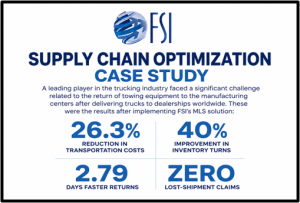
The impact becomes particularly clear when you look at the numbers. FSI worked with a leading trucking equipment manufacturer that was dealing with an inefficient and expensive process for returning towing equipment to its manufacturing facilities after deliveries. Multiple less-than-truckload (LTL) carriers resulted in high transportation costs, missed pickups, and an increasingly complicated administrative process.
FSI redesigned the operation around a regional consolidation network, combining local facilities and regional warehouses across North America with FSI’s asset-based fleet and trusted private carriers. The solution also introduced real-time shipment tracking, centralized communication, and support for documentation and customs requirements.
THE RESULTS
- 26.3% reduction in transportation costs
- 40% improvement in inventory turns
- 2.79 days faster returns
- Zero lost-shipment claims
The manufacturer also went from managing multiple carriers and invoices to having a single point of contact and one consolidated invoice.
Those improvements demonstrate the larger value of supply chain optimization. The goal wasn’t simply to find a cheaper way to move an individual shipment. It was to improve the transportation system as a whole, creating greater visibility, efficiency, and scalability.
Choosing a Partner Instead of a Provider
The most successful manufacturers don’t simply look for a company that can move freight. They look for a logistics partner that understands how transportation affects production schedules, inventory management, customer satisfaction, and long-term business performance. That’s an important distinction as a business grows.
Individual carriers and freight brokers can remain valuable parts of a transportation network. But when manufacturers reach a point where they are coordinating multiple modes, carriers, facilities, suppliers, and destinations, managing those pieces strategically becomes increasingly important.
A managed logistics or 4PL approach provides oversight across those moving parts, helping manufacturers see the bigger picture and make decisions based on the performance of the entire supply chain rather than one shipment at a time.
For manufacturers focused on sustainable growth, that can mean lower costs, greater visibility, less administrative burden, and a supply chain that is better prepared to scale alongside the business.
At FSI, our role is to help manufacturers build and manage transportation strategies that support where their businesses are today and where they’re headed next.
Ready to fortify your supply chain? Contact us today to see how FSI can help your business grow sustainably.

How the Right Freight Partner Keeps Your Supply Chain Moving Smoothly
How the Right Freight Partner Keeps Your Supply Chain Moving Smoothly
A smooth-running supply chain can feel invisible when everything is working the way it should. Products arrive on time, inventory stays where it needs to be, production schedules stay intact, and customers rarely think twice about delivery timelines.
But when something goes wrong, the impact can be immediate. A delayed shipment can slow production. Missing inventory can disrupt schedules. Poor communication or lack of shipment visibility can quickly create frustration across operations, customer service, and leadership teams.
For manufacturers, agricultural operations, medical suppliers, distributors, and industrial businesses, supply chain disruptions are more than inconvenient. They can be expensive. That is why choosing the right freight partner matters.
A strong logistics partner does far more than move freight from one location to another. They help reduce risk, improve visibility, solve problems before they escalate, and keep supply chains operating smoothly even when conditions change.
Freight Is Only One Part of the Equation
Many companies think of freight in simple terms: book transportation, move products, confirm delivery. In reality, successful logistics management is much more complex. Every shipment is influenced by factors such as:
- Carrier availability
- Weather disruptions
- Customs requirements for international shipments
- Capacity constraints
- Documentation accuracy
- Tariffs and trade changes
- Warehouse timing and appointments
- Production schedules and inventory planning
The right freight partner helps coordinate these moving pieces so businesses are not left reacting to problems after they happen. Instead of simply responding to issues, they focus on preventing disruptions in the first place. That shift—from transportation provider to logistics partner—is often what makes the biggest difference.
Visibility Matters More Than Ever
One of the biggest challenges companies face today is visibility. It is difficult to make informed decisions when teams do not know exactly where shipments are, when products will arrive, or what delays may be developing in real time. Without visibility, operations often fall back on rough estimates and reactive decision-making. A strong freight partner provides tracking, communication, reporting, and data that allow businesses to make smarter operational decisions.
For example, one international industrial shipper experiencing rapid growth found that managing its increasingly complex global transportation network became difficult as shipment volume expanded. The issue was not simply transportation capacity. It was visibility. When FSI helped them find solutions to real-time tracking and shipment data, they gained more control over their operations and were able to provide customers with more accurate information.
While every business faces different challenges, the lesson is universal: supply chain visibility reduces uncertainty.
Problem-Solving Is Just as Important as Transportation
Even the best supply chains experience disruptions. A truck breaks down. Severe weather changes transit plans. Documentation errors create delays. Capacity tightens unexpectedly. The difference between a smooth operation and a costly disruption often comes down to how quickly problems are identified and solved.
A strong freight partner brings experience, contingency planning, and communication strategies that help reduce downtime and keep freight moving. Sometimes, solving a logistics challenge means rethinking the process entirely.
In one case, a manufacturer shipping specialty surgical tables struggled with recurring damage during transportation. Rather than treating the issue as unavoidable, FSI evaluated handling practices, carrier selection, packaging, and training opportunities to reduce shipping issues and improve shipment outcomes.
The takeaway is not simply that freight arrived in better condition. It is that proactive logistics management helped reduce risk. That is what strong supply chain partnerships should do.
Risk Reduction Is the Real Goal
Businesses often evaluate freight providers based on cost alone. But focusing only on price can overlook larger operational risks. What happens when a delayed shipment halts production? What happens when poor communication leaves customers waiting for answers? What happens when limited visibility makes planning difficult? The right freight partner helps businesses think beyond transportation costs and consider the bigger picture. Reliable logistics can help reduce:
- Costly production delays
- Inventory disruptions
- Damage claims and shipping issues
- Communication gaps
- Missed deadlines
- Unnecessary stress across teams
In many cases, a stronger logistics strategy saves money by preventing expensive problems before they occur.
Choosing the Right Freight Partner
Not every logistics provider offers the same level of support. When evaluating a freight partner, businesses should look for more than shipping capacity. Some important questions to ask include:
- Do they provide visibility and tracking?
- Can they support domestic and international shipping needs?
- Do they understand industry-specific challenges?
- How do they handle disruptions or delays?
- Can they scale as your business grows?
- Do they act proactively or reactively?
The best logistics relationships feel collaborative. Instead of simply moving freight, the right partner becomes an extension of your operations team—helping reduce risk, solve problems, and create stability in an increasingly complex supply chain environment.
A Supply Chain Partner, Not Just a Transportation Provider
At the end of the day, smooth supply chains are rarely accidental. They are built through planning, communication, visibility, and proactive problem-solving. The right freight partner helps businesses stay agile, navigate disruptions, and keep products moving without unnecessary friction.
Because logistics is not just about transportation. It is about helping your business move forward with confidence.
Ready to up your shipping game with a trusted logistics partner, FSI is here to help! Contact us today to discuss your business needs.
What Does It Mean to Be NVOCC Certified?
If your business relies on international shipping, you’ve probably come across the term NVOCC. So, what does it actually mean? And why does it matter?
NVOCC stands for Non-Vessel Operating Common Carrier. While the name sounds technical, the concept is simple: an NVOCC is a company that manages ocean freight transportation without owning the ships themselves.
Instead of operating vessels, an NVOCC works as a transportation partner that books cargo space with ocean carriers, coordinates international shipments, manages documentation, and helps businesses move freight efficiently across global supply chains.
For companies shipping internationally, working with an NVOCC-certified provider adds an important layer of expertise, compliance, and reliability.
What Does an NVOCC Do?
An NVOCC acts as the bridge between shippers and ocean carriers.
They consolidate shipments, negotiate freight rates, coordinate container movement, issue bills of lading, and help manage the many details involved in international ocean freight.
This includes:
- Booking cargo space with shipping lines
- Managing import and export documentation
- Coordinating customs requirements
- Handling port logistics and container movement
- Providing shipment visibility and communication
- Helping resolve delays, disruptions, or compliance issues
In short, they simplify a very complicated process.
For businesses that don’t have an in-house international shipping department, an experienced NVOCC becomes a critical logistics partner.
What Does “Certified” Mean?
Being NVOCC certified means a company meets the legal and regulatory requirements to operate as a Non-Vessel Operating Common Carrier.
In the United States, this includes registration and compliance through the Federal Maritime Commission (FMC), along with financial responsibility requirements such as bonds and licensing standards.
This certification is important because it ensures the company is operating within federal regulations and has the authority to handle international ocean freight properly.
It also demonstrates accountability.
International shipping involves major financial, operational, and compliance risks. Businesses need confidence that their logistics provider understands the rules, follows the correct procedures, and can protect shipments from unnecessary delays or costly mistakes.
Why NVOCC Certification Matters for Customers
When choosing a logistics partner, certification matters because trust matters.
Ocean freight is rarely simple. Delays at ports, customs requirements, documentation errors, and shifting international regulations can quickly create problems if shipments are not managed correctly.
An NVOCC-certified provider helps reduce that risk.
It means your logistics partner can:
- Manage ocean freight legally and professionally
- Provide accurate documentation and bills of lading
- Navigate customs and compliance requirements
- Coordinate cross-border transportation more effectively
- Offer stronger visibility and shipment control
- Help prevent avoidable delays and added costs
For customers, that translates to smoother operations, fewer surprises, and better protection for your supply chain.
NVOCC vs. Freight Forwarder
These two terms are often used together, but they are not exactly the same. A freight forwarder helps arrange transportation and coordinate shipping services across multiple modes, including air, ocean, and ground. An NVOCC focuses specifically on ocean freight and operates as a carrier to the shipper, even though they do not own the vessel.
In many cases, a logistics provider may offer both services, giving customers a more complete international shipping solution. The key difference is that an NVOCC can issue its own bill of lading and assumes greater responsibility for the cargo movement. That added responsibility is one reason certification matters so much.
Why It Matters at Freight Services Inc.
At Freight Services Inc., global logistics means more than moving containers from one port to another. It means helping customers navigate international trade with confidence. As an NVOCC-certified provider, FSI supports businesses with ocean freight coordination, cross-border expertise, customs support, documentation management, and the strategic visibility needed to keep freight moving efficiently.
Our team understands that every shipment affects production schedules, customer relationships, and business profitability. That’s why compliance, communication, and proactive problem-solving are built into every move. Because in global logistics, experience matters—but certified expertise matters even more.
Work with FSI
NVOCC certification is not just an industry label. It represents trust, compliance, and the ability to manage international ocean freight the right way. For businesses shipping globally, choosing the right logistics partner can mean the difference between smooth operations and costly disruptions.
Working with an NVOCC-certified provider helps protect your freight, your timelines, and your bottom line. And when global shipping gets complicated, having the right partner makes all the difference. Contact us today if you’re ready to take your shipping operations to the next level.

Agricultural Freight Challenges: How Smart Logistics Keep Perishables Moving
Moving agricultural products from farms to processors, distributors, and retailers sounds simple in theory. In reality, it’s one of the most complex segments of global logistics. Agricultural freight is uniquely sensitive to time, temperature, regulations, and unpredictable environmental conditions. A delay that might be inconvenient in other industries can be disastrous when transporting perishable products.
From fresh produce and animal feed to temperature-sensitive ingredients, companies operating in the agricultural supply chain face constant pressure to move goods quickly, safely, and efficiently. Even small disruptions—weather delays, port congestion, or regulatory issues—can compromise product quality and profitability.
Understanding the most common agricultural freight challenges is the first step toward overcoming them. With the right logistics strategy and an experienced logistics partner, companies can protect product integrity, reduce waste, and keep perishable shipments moving smoothly.
Time Sensitivity in the Agricultural Supply Chain
Perhaps the biggest challenge in agricultural logistics is time. Many agricultural products have extremely limited shelf lives. Fresh fruits and vegetables, dairy products, and certain grains can quickly deteriorate if shipments are delayed or mishandled.
Unlike durable goods, agricultural shipments often operate on tight harvest and delivery schedules. Produce harvested in the morning may need to be transported to a processing facility or distribution center within hours. Any disruption along the route can affect freshness and market value.
This is why efficient ag supply chain management is essential. Coordinated logistics planning ensures that transportation, storage, and delivery timelines are aligned with harvest cycles and market demand.
Smart logistics planning helps companies:
- Reduce transit times
- Coordinate shipments with harvest schedules
- Minimize delays at transfer points
- Maintain consistent product quality
When logistics providers understand the urgency of agricultural shipments, they can design transportation strategies that prioritize speed and reliability.
Temperature Control and Product Integrity
When shipping perishables, temperature management becomes a critical factor. Even small temperature fluctuations can affect freshness, shelf life, and food safety.
Agricultural products often require specific storage conditions throughout the journey, whether moving across a state or across continents. Refrigerated trucks, temperature-controlled containers, and carefully managed cold chains are essential for protecting product integrity.
The challenge is maintaining these conditions across multiple stages of transportation. A shipment might move from a farm to a packing facility, then to a cold storage warehouse, followed by transport to a port or distribution center.
Without coordinated logistics for agriculture, maintaining temperature consistency across these transitions becomes difficult.
Modern agricultural logistics strategies rely on:
- Refrigerated transportation
- Temperature monitoring technology
- Cold storage coordination
- Rapid transfer between transport stages
By implementing strong cold chain management practices, companies can significantly reduce spoilage and protect the value of their products.
Regulatory Compliance and Documentation
Agricultural shipments are subject to a wide range of regulatory requirements as well. Depending on the product and destination, shipments may need to meet food safety regulations, export documentation standards, and agricultural inspection requirements.
For companies shipping perishable agriculture products internationally, compliance becomes even more complex. Customs documentation, phytosanitary certificates, and import regulations must all be handled correctly to avoid delays.
Even minor documentation errors can result in shipments being held at ports or border crossings. When dealing with perishable goods, these delays can quickly lead to spoilage or loss of product value.
Strong ag supply chain management includes careful coordination of regulatory requirements and documentation processes. Logistics providers with experience in agricultural freight understand the specific compliance requirements that apply to different products and destinations.
This expertise helps ensure that shipments move through customs smoothly and arrive at their destination without unnecessary delays.
Seasonal Demand and Capacity Constraints
Agriculture operates on seasonal cycles, which can create significant fluctuations in freight demand. During harvest seasons, transportation networks often experience spikes in volume as large quantities of crops need to move quickly.
These seasonal surges can create capacity challenges, particularly when refrigerated equipment or specialized transportation is required. Without careful planning, companies may struggle to secure the equipment and transportation resources needed to move their products efficiently.
Managed logistics providers help companies anticipate these seasonal patterns and secure transportation capacity in advance. By planning around harvest schedules and regional production cycles, logistics teams can help agricultural businesses maintain consistent freight movement even during peak seasons.
Proactive planning ensures that transportation resources are available when demand rises, reducing the risk of costly shipping delays.
Supply Chain Visibility and Coordination
Agricultural supply chains often involve multiple stakeholders, including farmers, processors, warehouses, carriers, and distributors. Coordinating all of these moving parts requires strong communication and visibility.
Without clear oversight, shipments can become delayed at transfer points, misrouted between facilities, or held in storage longer than intended. For perishable goods, these breakdowns in coordination can have serious consequences.
Effective ag supply chain management depends on strong logistics coordination and real-time communication between all parties involved in the shipment.
Modern logistics solutions provide greater visibility into shipment status, transportation timelines, and inventory locations. This visibility allows businesses to identify potential disruptions early and take corrective action before product quality is affected.
With the right logistics partner, companies gain a clearer picture of their entire agricultural supply chain, helping them make better operational decisions and maintain smoother freight movement.
How Managed Logistics Supports Agricultural Freight
Because agricultural shipments are so time-sensitive and condition-dependent, many companies rely on managed logistics for agriculture to handle the complexity of moving perishable goods.
Managed logistics services provide a centralized approach to transportation planning, carrier coordination, and supply chain oversight. Rather than managing every shipment internally, companies can rely on logistics professionals who specialize in agricultural freight.
A managed logistics strategy can provide:
- Coordinated transportation planning
- Carrier network access
- Cold chain management support
- Regulatory compliance guidance
- Improved supply chain visibility
By centralizing these responsibilities, businesses can focus more on production and distribution while ensuring their freight operations run efficiently.
Keeping Perishable Freight Moving
Agricultural logistics will always present challenges. Time sensitivity, regulatory requirements, seasonal demand, and cold chain management all add layers of complexity to moving agricultural products.
However, with the right logistics strategy, these challenges can be effectively managed. Strong planning, reliable transportation networks, and experienced logistics coordination help ensure that perishable goods arrive safely and on time.
Freight Services Inc. works closely with agricultural producers, processors, and distributors to design logistics strategies that support the unique demands of the agricultural industry. Through coordinated planning and dependable transportation networks, businesses can maintain product quality, reduce waste, and keep their agricultural supply chains moving efficiently.
In an industry where timing and product integrity are everything, smart logistics make all the difference.
Contact us today to see how we can help streamline your ag shipments.
Navigating Tariffs and Trade Changes with a Strategic 3PL
Global trade has always involved complexity, but in recent years that complexity has intensified. Tariffs shift, trade agreements evolve, and geopolitical tensions can alter the economics of sourcing almost overnight. For companies that rely on international supply chains, these changes can dramatically affect costs, timelines, and overall profitability.
Many businesses try to absorb these changes internally, but managing tariffs and trade compliance requires deep expertise and constant monitoring. This is where a strategic third-party logistics provider (3PL) can make a major difference.
A strong logistics partner doesn’t simply move freight from point A to point B. The best providers help businesses adapt to global trade changes, reduce tariff exposure, and build supply chains that are flexible enough to withstand disruption.
Freight Services Inc (FSI) approaches logistics with exactly this mindset—helping companies manage risk, optimize costs, and maintain global operational continuity.
Supply Chain Diversification and Risk Mitigation
One of the most effective ways to reduce tariff exposure is by diversifying sourcing locations and transportation routes. When companies rely too heavily on a single country of origin or a single trade lane, they become vulnerable to sudden tariff increases, regulatory changes, or geopolitical tensions.
Diversification allows businesses to shift production or routing strategies when conditions change, reducing financial risk and ensuring supply chain continuity.
FSI supports this strategy through its extensive global network of agent partners in key manufacturing regions where production continues to expand. This network provides businesses with greater flexibility when navigating global trade uncertainty.
Through this network, companies gain access to alternative sourcing options and transportation routes that may be more favorable from both a cost and compliance standpoint. When tariffs change or trade regulations evolve, shipments can be quickly rerouted through different carriers, ports, or regions to maintain efficiency and cost control.
Rather than relying on a single origin or trade lane, businesses working with FSI benefit from a logistics strategy built around adaptability. This ability to pivot quickly is a key component of modern supply chain resilience and plays an important role in reducing tariff exposure.
Operational and Financial Optimization
Tariffs affect more than just customs paperwork. They influence total landed cost, inventory strategies, transit time decisions, and even product pricing. Without a clear understanding of these impacts, businesses may unknowingly absorb unnecessary costs.
An experienced 3PL helps companies evaluate these factors and develop logistics strategies that support both operational efficiency and financial performance.
FSI takes a holistic approach to logistics planning by combining traditional freight services with value-added customs and regulatory consulting. This allows businesses to evaluate the full financial impact of their supply chain decisions.
For example, FSI works with clients to model landed costs across different transportation modes and routing options. By evaluating transit times alongside tariff structures, companies can determine whether ocean freight, air freight, or multimodal solutions provide the best overall value.
In addition, FSI helps businesses minimize tariff burdens through strategic planning and improved product classification. Accurate Harmonized Tariff Schedule (HTS) coding plays a critical role in determining duty rates. Misclassification can lead to higher tariffs, unexpected audits, or compliance penalties.
By integrating logistics execution with duty optimization strategies, FSI helps companies create supply chains that are not only operationally efficient but also financially optimized.
Customs Compliance and Regulatory Expertise
As tariffs evolve, customs compliance becomes increasingly complex. Companies must ensure that product classifications, country-of-origin documentation, and valuation practices all meet regulatory requirements. Even minor errors in documentation or classification can result in delays, fines, or unnecessary duties.
For businesses moving freight internationally, compliance is not optional—it is a critical part of maintaining reliable operations.
FSI brings deep expertise in customs brokerage and trade compliance across North America and global markets. This expertise allows companies to navigate complex customs environments with confidence.
The FSI team provides support with classification strategies, valuation practices, and regulatory documentation to ensure that shipments move smoothly through customs. When trade regulations change, clients receive guidance on how those changes affect their logistics operations and what adjustments may be necessary.
In addition to ensuring compliance, FSI also helps companies reduce costly disruptions caused by customs bottlenecks. Delays at ports and airports can quickly lead to demurrage and storage fees, especially when documentation issues slow down clearance.
By proactively managing customs requirements and offering alternative logistics solutions when needed, FSI helps minimize these risks and keep shipments moving efficiently.
Global Agent Network and Operational Coverage
Global trade requires coordination across multiple regions, regulatory environments, and transportation systems. Logistics providers that operate within limited geographic areas often struggle to maintain continuity when trade conditions shift.
A world-class 3PL must be able to support clients across continents while maintaining consistent service standards. Having successfully set up our own cross border business, this is an area FSI excels at.
FSI achieves this through a robust global network of trusted agent partners. These partnerships allow FSI to provide seamless logistics coordination across international markets while leveraging local expertise in each region.
Local partners understand the regulatory environments, transportation infrastructure, and operational nuances of their markets. At the same time, FSI ensures that shipments are managed according to consistent global standards from origin to destination.
This combination of global oversight and local expertise ensures that businesses receive reliable service regardless of where their goods are moving.
For companies expanding into new markets or diversifying their supply chains, this global coverage provides a critical advantage. Businesses can scale their operations or adjust sourcing strategies without sacrificing logistics reliability.
Building a More Resilient Global Supply Chain
In today’s rapidly evolving trade environment, tariffs and regulatory changes are no longer occasional challenges—they are ongoing realities. Companies that rely on rigid supply chains often struggle to adapt when these changes occur.
Resilience requires flexibility, strategic planning, and access to global logistics expertise.
A strong 3PL partner provides the tools and insights businesses need to navigate these challenges effectively. From diversifying sourcing strategies to optimizing landed costs and ensuring regulatory compliance, the right logistics provider becomes an extension of the company’s supply chain strategy.
Freight Services Inc helps businesses build supply chains that are not only efficient but also adaptable to changing global conditions. With a strong international partner network, deep customs expertise, and a focus on operational optimization, FSI supports companies as they navigate tariffs, manage risk, and pursue sustainable global growth.
In an increasingly unpredictable trade environment, that kind of strategic support can make all the difference between reacting to disruptions and staying ahead of them. Contact us today to see how we can help you grow a strong and efficient business while navigating trade complexity and tariffs.

How To Build Supply Chain Resilience In A Volatile Global Market
In today’s fast-moving global economy, supply chains face unprecedented challenges. Trade tensions, geopolitical uncertainties, labor shortages, fluctuating fuel prices, and unexpected disruptions like natural disasters or pandemics can all create significant supply chain problems. For manufacturers, automotive companies, and other businesses that rely on complex logistics networks, these disruptions can have costly consequences. The key to staying competitive is building supply chain resilience—the ability to anticipate, adapt to, and recover from these challenges.
Understanding Supply Chain Resilience
Supply chain resilience is more than just risk management. It’s a strategic approach that allows companies to maintain operations, meet customer expectations, and recover quickly from disruptions. Companies with resilient supply chains can respond flexibly to changes in demand, transportation delays, or supplier issues without significant financial loss.
Building resilience requires a deep understanding of your entire supply chain, from sourcing raw materials to delivering finished products. Companies that invest in resilience are better equipped to handle volatility and maintain a steady flow of goods, even in uncertain conditions.
Common Supply Chain Problems
Supply chain problems can arise from a variety of sources, including:
- Global disruptions: Natural disasters, geopolitical conflicts, or pandemics (as we are all now well aware) can suddenly halt production or transportation.
- Supplier dependency: Overreliance on a single supplier or region increases risk if that supplier faces disruption.
- Logistics inefficiencies: Poorly managed shipping, customs delays, or inadequate warehousing can slow operations.
- Demand fluctuations: Rapid changes in customer demand, whether seasonal or market-driven, can create inventory imbalances.
- Transportation bottlenecks: Port congestion, limited freight capacity, and rising fuel costs can cause delays and cost overruns.
Addressing these challenges requires a proactive, integrated approach, something that managed logistics services can provide.
Benefits of Managed Logistics
Partnering with a global logistics company or global logistics agency offers significant advantages fo
r building supply chain resilience:
- End-to-end visibility: Managed logistics providers offer real-time tracking of shipments, inventory, and supply chain performance. This transparency allows companies to anticipate issues and make data-driven decisions.
- Flexible solutions: From air and sea freight to trucking and warehousing, managed logistics providers can quickly adapt to disruptions and find alternative routes or methods.
- Cost efficiency: By consolidating shipments, optimizing routes, and leveraging global networks, managed logistics reduces transportation costs and minimizes risk. And speaking of risk…
- Risk mitigation: Experienced logistics partners can identify potential vulnerabilities in your supply chain and implement strategies to reduce exposure.
For businesses in most industries, including the automotive industry or manufacturers of any scale, leveraging managed logistics is not just a convenience, it’s a strategic necessity.
Strategies to Enhance Supply Chain Resilience
There are several strategies companies can implement to strengthen their supply chains:
1. Diversify Suppliers and Sources
Relying on a single supplier or geographic region can leave your business vulnerable. Consider diversifying your suppliers across different regions or countries. Nearshoring—bringing production closer to your primary markets, such as in Mexico or other nearby countries—can reduce lead times, lower shipping costs, and mitigate risks associated with long international supply chains.
2. Implement Advanced Planning and Analytics
Data-driven decision-making is essential for resilient supply chains. Using predictive analytics and advanced planning tools allows companies to forecast demand more accurately, identify potential bottlenecks, and optimize inventory levels. This approach helps prevent stockouts and overstock situations, reducing financial risk.
3. Build Strategic Inventory Buffers
Maintaining safety stock or strategic inventory buffers can provide a cushion against sudden disruptions. While this may increase holding costs slightly, it ensures that your company can continue operations when supply chain problems occur, avoiding production halts or delayed deliveries.
4. Strengthen Supplier Relationships
Strong partnerships with suppliers can improve communication, collaboration, and flexibility. Regular engagement, transparent expectations, and joint contingency planning help ensure suppliers are prepared to respond to disruptions, ultimately protecting your supply chain integrity.
5. Leverage Technology and Automation
Technologies like warehouse automation, transportation management systems (TMS), and real-time tracking platforms increase efficiency and visibility across the supply chain. Automation reduces human error, accelerates processes, and provides actionable insights to prevent disruptions before they escalate.
6. Develop Contingency and Risk Management Plans
Every resilient supply chain has a plan for unexpected disruptions. Companies should identify critical risks, develop alternative sourcing strategies, and prepare emergency response protocols. Scenario planning for various risks, such as natural disasters, port closures, or supplier insolvency, ensures that the organization can respond quickly and decisively.
The Role of Global Logistics Partners
Working with a global logistics agency like Freight Services, Inc. provides the expertise and infrastructure to implement these strategies effectively. A capable logistics partner can manage international freight, coordinate cross-border compliance, optimize transportation routes, and provide solutions tailored to specific industries.
For instance, logistics for manufacturers often requires just-in-time delivery, precision scheduling, and handling of sensitive materials. Meanwhile, logistics for the automotive industry demands integration across multiple suppliers, assembly plants, and distribution centers. A global logistics provider ensures that every link in the chain is monitored and managed, reducing the impact of unexpected disruptions.
Nearshoring as a Resilience Strategy
Nearshoring has emerged as a key tactic for supply chain resilience. By relocating production closer to end markets, companies can reduce dependency on distant suppliers, shorten lead times, and gain greater flexibility. Nearshoring also provides a buffer against global shipping disruptions, currency fluctuations, and international trade uncertainties.
Freight Services Inc. is well-equipped to assist companies pursuing nearshoring—whether they are shifting operations or managing and expanding existing cross-border supply chains. With a presence in both the U.S. and Mexico, FSI ensures smooth coordination across borders, enhanced shipment visibility, and rapid problem-solving when timing is critical. Our experts are deeply familiar with U.S.–Mexico trade regulations, customs procedures, and regional logistics networks, enabling clients to move products efficiently, compliantly, and with complete peace of mind.
What About Tariffs and Supply Chain Resilience?
Shifting trade policies and fluctuating tariff rates have become a major source of supply chain uncertainty. Tariffs can quickly raise the cost of raw materials and finished goods, disrupt sourcing strategies, and complicate long-term planning, especially for manufacturers and automotive companies that rely on international suppliers. Managing tariff exposure is now a critical component of supply chain resilience.
One effective approach is diversifying sourcing and manufacturing locations to reduce reliance on tariff-heavy regions. Strategies like nearshoring or “China-plus-one” sourcing help companies spread risk, shorten transit times, and create more flexible logistics networks. Evaluating total landed cost (rather than unit price alone) also allows businesses to account for duties, compliance, and transportation when making sourcing decisions.
A knowledgeable logistics partner plays a key role in navigating tariffs. Managed logistics providers bring expertise in customs classification, trade compliance, and cross-border regulations, helping companies avoid costly errors and delays. Just as importantly, enhanced supply chain visibility allows businesses to identify where tariff exposure is highest and adjust routing, inventory placement, or sourcing strategies before costs escalate.
With proactive planning, diversified sourcing, and the right logistics support, tariffs become a manageable factor rather than a disruptive force.
Building Resilience is an Ongoing Process
Supply chain resilience is not a one-time effort. It requires continuous monitoring, evaluation, and improvement. Companies must stay informed about global market trends, regulatory changes, tariffs, and emerging risks. Regularly reviewing supply chain performance and adjusting strategies ensures businesses remain agile, competitive, and capable of weathering volatility.
By partnering with an experienced global logistics company like FSI, businesses can enhance their supply chain resilience, reduce the impact of disruptions, and maintain customer satisfaction even in the most unpredictable markets. Whether your company is focused on manufacturing, automotive production, agriculture, bioskills, international distribution, or another global industry, a proactive logistics strategy is essential for long-term success.
Ready to strengthen your supply chain? Contact us today and let FSI help your business stay resilient and efficient.

The Rise Of Nearshoring | Why U.S. Companies Look To Mexico
Over the past decade, global supply chains have undergone a major reckoning. Trade disruptions, geopolitical tensions, rising labor costs overseas, and ongoing transportation volatility have forced U.S. companies to rethink where (and how) they manufacture and source goods. One strategy has gained significant momentum as a result: nearshoring.
Rather than relying exclusively on distant offshore production, more U.S. businesses are moving manufacturing and supplier operations closer to home, with nearshoring in Mexico emerging as a top choice. For companies navigating today’s complex global logistics landscape, Mexico offers a compelling blend of proximity, cost efficiency, and supply chain resilience.
What Is Nearshoring?
Nearshoring refers to relocating manufacturing or sourcing operations to countries geographically closer to the end market. For U.S. companies, this often means shifting production from Asia to Mexico, Central America, or parts of Latin America.
Unlike offshoring, which prioritizes the lowest labor cost regardless of distance, nearshoring balances cost with speed, flexibility, and risk reduction. As global logistics challenges continue to evolve, many nearshoring companies see this approach as a long-term strategic advantage rather than a short-term fix.
Why Nearshoring Is Accelerating Now
The rise of nearshoring didn’t happen overnight. Several converging factors have pushed it from a niche strategy into a mainstream supply chain solution.
1. Supply Chain Disruptions Exposed Weaknesses
Pandemic-related shutdowns, port congestion, container shortages, and factory closures revealed how fragile long-distance supply chains can be. Companies dependent on Asia-based production faced extended lead times and unpredictable delays, often lasting weeks or months.
Nearshoring shortens supply chains dramatically, giving companies more control and faster recovery when disruptions occur.
2. Rising Costs in Traditional Offshore Markets
While Asia once offered significant labor savings, wages, fuel costs, and compliance expenses have steadily increased. When combined with rising ocean freight rates and longer transit times, the total landed cost of offshore production is no longer as competitive as it once was.
Mexico, by contrast, offers competitive labor costs without the expense and uncertainty of intercontinental shipping.
3. Demand for Faster Time-to-Market
Consumer expectations have changed. Whether B2B or B2C, customers expect shorter lead times and more reliable delivery schedules. Nearshoring allows companies to respond faster to demand shifts, seasonal fluctuations, and product changes—an advantage that distant production simply can’t match.
Why Mexico Is the Nearshoring Destination of Choice
When it comes to nearshoring, Mexico stands out as a strategic hub for U.S. businesses across multiple industries, including automotive, electronics, aerospace, consumer goods, and industrial manufacturing.
Proximity to the U.S. Market
Mexico’s close geographic location enables faster transportation by truck or rail, often reducing transit times from weeks to days. This proximity supports leaner inventory strategies, lower carrying costs, and improved supply chain visibility.
For companies working with experienced global logistics companies, cross-border shipping from Mexico can be both efficient and highly predictable.
Strong Trade Frameworks
The United States–Mexico–Canada Agreement (USMCA) provides a stable trade environment with reduced tariffs and clearer rules of origin. This agreement has encouraged investment and made Mexico an even more attractive option for nearshoring companies looking to mitigate trade risks.
Skilled Workforce and Manufacturing Infrastructure
Mexico has spent decades building a robust manufacturing ecosystem. Many regions offer skilled labor, modern industrial parks, and suppliers experienced in serving U.S. companies. This mature infrastructure reduces ramp-up time and allows businesses to scale more quickly than in emerging offshore markets.
Cultural and Time Zone Alignment
Operating in similar time zones simplifies communication, collaboration, and oversight. Teams can coordinate in real time, resolve issues faster, and maintain stronger supplier relationships, an often-overlooked but critical benefit of nearshoring in Mexico.
The Role of Global Logistics in Nearshoring Success
While nearshoring offers clear advantages, execution matters. Cross-border supply chains come with their own complexities, including customs compliance, transportation coordination, and regulatory requirements. This is where experienced global logistics companies play a critical role.
A strong logistics partner helps nearshoring companies:
- Navigate customs clearance and documentation
- Optimize transportation routes and modes
- Ensure compliance with USMCA regulations
- Manage cross-border risk and contingency planning
- Improve visibility across the entire supply chain
Without the right logistics strategy, the benefits of nearshoring can be diminished by delays, inefficiencies, or unexpected costs.
Key Benefits of Nearshoring to Mexico
For U.S. companies weighing their options, the benefits of nearshoring extend well beyond cost savings.
Increased Supply Chain Resilience
Shorter, regional supply chains are inherently more resilient. Companies can adapt more quickly to disruptions, supplier changes, or shifts in demand without being overly exposed to global shocks.
Reduced Transportation Risk and Emissions
Nearshoring reduces reliance on long ocean routes, lowering the risk of port congestion and geopolitical disruptions. It also supports sustainability goals by reducing transportation-related emissions.
Better Inventory Management
With faster replenishment cycles, companies can move away from excessive safety stock and improve cash flow. This agility is especially valuable in industries with volatile demand or frequent product updates.
Enhanced Quality Control
Closer proximity allows for more frequent site visits, tighter quality oversight, and stronger supplier accountability—factors that directly impact customer satisfaction and brand reputation.
Industries Leading the Nearshoring Movement
While nearshoring spans many sectors, some industries are moving particularly fast:
- Automotive and EV manufacturing, driven by regional content requirements
- Electronics and technology, seeking faster innovation cycles
- Consumer goods, responding to e-commerce demand
- Industrial manufacturing, prioritizing reliability and uptime
For these sectors, nearshoring in Mexico is more than just a logistics decision, it can be a solid competitive strategy.
Looking Ahead: Nearshoring as a Long-Term Strategy
Nearshoring is no longer a temporary reaction to global disruption. It represents a fundamental shift in how U.S. companies think about production, risk, and logistics. As supply chains continue to regionalize, Mexico’s role as a manufacturing and logistics partner is only expected to grow.
Companies that invest early, supported by knowledgeable logistics partners, will be better positioned to scale, adapt, and compete in an increasingly unpredictable global environment.
Final Thoughts
Nearshoring is more than a strategic shift, it’s an operational commitment that requires deep expertise in cross-border logistics, regulatory compliance, and real-time coordination. To fully realize the benefits of nearshoring in Mexico, U.S. companies need a logistics partner that understands both sides of the border. Not just on paper, but on the ground.
Freight Services Inc. is uniquely positioned to support nearshoring companies—both those transitioning operations and those already operating and scaling established cross-border supply chains. With offices in both the United States and Mexico, FSI provides seamless coordination across borders, greater visibility into shipments, and faster issue resolution when it matters most. Our teams understand the nuances of U.S.–Mexico trade, customs requirements, and regional transportation networks, helping clients move goods efficiently, compliantly, and with confidence.
As global supply chains continue to regionalize, FSI delivers the experience, infrastructure, and personalized service companies need to turn nearshoring into a long-term competitive advantage. Whether you’re just beginning to explore nearshoring or actively scaling operations in Mexico, FSI is ready to help ensure your logistics strategy is built for resilience, speed, and growth.
Contact us today to see how we can help your business grow and thrive.
Read this case study to see how FSI helped one business move their manufacturing machines from Shenzhen, China to Sonora, Mexico.

Precision in Motion: How Specialized Medical Logistics Save Lives
In the world of modern medicine, precision isn’t a luxury—it’s a lifeline. Whether supporting a new clinical study, delivering equipment for bioskills training, or transporting tissue needed for research breakthroughs, the flow of medical materials has to be fast, compliant, and dependable. That’s where specialized medical logistics comes in.
Medical logistics plays a quieter role in the healthcare ecosystem, but it’s one of the most influential. Behind every surgical innovation, every research milestone, every new medical device—or even the training that prepares doctors to use it—there’s an intricate chain of planning, transportation, handling, and verification. When a provider fumbles this chain, progress stalls. When a logistics partner gets it right, knowledge moves forward and patient outcomes improve.
At Freight Services Inc. (FSI), specialized medical logistics is more than just a service, it’s one of the ways we help move the medical field forward every day.
What Is Medical Logistics?
Medical logistics refers to the planning, storing, transporting, and tracking of sensitive medical materials. These items can include:
- Tissue samples for research
- Medical devices and surgical tools
- Equipment for bioskills labs
- Supplies for clinical trials
- Temperature-sensitive materials requiring cold chain logistics
- Specialized gear for hospitals, universities, and simulation centers
Unlike standard shipping, medical logistics requires heightened compliance, precise timing, specialized vehicles, trained handlers, and custom packing methods designed to protect sensitive, often irreplaceable materials.
For many organizations—from tissue banks to research institutions—their work is only as strong as the logistics supporting it. This is where a partner like FSI shines.
Advancing Medicine, Not Just Transporting Materials
When we say specialized medical logistics “save lives,” it’s not about rushing organs to the operating room, although that segment of specialized logistics is absolutely crucial. FSI’s role is different—and equally important.
FSI’s day-to-day work strengthens the entire medical ecosystem. By ensuring researchers, clinicians, universities, and bioskills training programs get the specimens, instruments, and equipment they need, when they need them, FSI helps push medicine forward. Each successful delivery supports discoveries, education, testing, and innovation that ultimately lead to improved treatments and healthier communities.
Precision in motion today means better patient outcomes tomorrow.
Tissue Bank Logistics: Where Detail Matters Most
Transporting tissue for research is one of the most demanding areas of medical logistics—and an area where FSI has deep experience.
These materials often require:
- Strict temperature control
- Regulated handling
- Verified chain of custody
- Rapid, predictable delivery
- Specialized packaging to protect integrity
A small deviation in temperature or timing can compromise valuable samples. FSI’s tissue bank logistics solutions are built around eliminating those risks. With trained drivers, temperature-controlled systems, and careful documentation at every step, they help ensure tissue arrives exactly as expected—ready for use in critical research programs, bioskills labs, and training events.
Bioskills Logistics: Supporting the Next Generation of Medical Training
Surgical innovation doesn’t start in an operating room—it starts in bioskills labs and training centers where medical professionals learn new techniques, test medical devices, and practice life-saving procedures in a controlled environment.
FSI plays a pivotal role in making these labs possible by transporting:
- Tissue for bioskills events
- Surgical instruments
- Medical devices
- Training equipment
- Lab supplies and consumables
The success of a bioskills event hinges on timing, condition, and preparation. FSI’s team understands the stakes, ensuring materials arrive intact, on schedule, and properly handled—so instructors and participants can focus on learning, not logistics.
Medical Equipment & Device Logistics: Protecting High-Value Assets
Medical equipment logistics is another area where expertise matters. From diagnostic machines to surgical tools to sterilized equipment, these items are delicate, expensive, and often mission-critical.
FSI uses specialized packing, custom crating, white-glove handling, and trained staff to prevent damage, reduce risk, and ensure safe delivery. Whether shipping across town or across the country, the goal is consistent: precision every time.
For device manufacturers, this reliability is essential. It helps them stay compliant, protect product integrity, support field reps, and reduce costly delays. For hospitals and universities, it ensures equipment is ready when needed—without downtime or disruption.
Clinical Trial & Medical Research Logistics: Keeping Progress on Track
Every clinical trial depends on the consistent flow of samples, supplies, and testing materials. Even a single late shipment can disrupt timelines or impact data quality.
FSI’s experience includes:
- Transporting lab materials between trial sites
- Managing temperature-sensitive cold chain logistics
- Handling documentation for compliance
- Supporting researchers with flexible, on-demand solutions
- Medical research logistics also extends into universities, biotech companies, and private labs. For all of them, precision logistics protects their research, their timelines, and their ability to move innovation forward.
In other words: every accurate delivery is another step toward the treatments, technologies, and insights the medical community is working so hard to achieve.
The Cold Chain: Where Precision Meets Temperature
Cold chain logistics is one of the most technically demanding aspects of medical transport. Sensitive materials—such as tissue for research, some lab reagents, medical supplies, and clinical trial samples—must stay at specific temperatures from pickup to final delivery.
FSI maintains strict protocols for:
- Continuous temperature monitoring
- Insulated and validated packaging
- Refrigerated and frozen transport
- Immediate verification upon delivery
When it comes to cold chain materials, “close enough” isn’t an option. FSI’s commitment to precision ensures that temperature-sensitive items arrive uncompromised, protecting research integrity and overall safety.
Why Precision Matters—Every Time
Specialized medical logistics is about more than trucks, crates, or temperature systems. It’s about trust. Researchers trust FSI so they can focus on discovery. Surgeons trust FSI so they can focus on mastering new techniques. Device companies trust FSI so they can focus on innovation. Tissue banks trust FSI so they can focus on advancing medical science.
FSI keeps medical progress moving—safely, reliably, and with expertise built on years of specialization.
In a field where timing is critical and materials are irreplaceable, FSI delivers more than shipments—they deliver confidence. Their work supports the systems, people, and discoveries that drive medicine forward.
Because when logistics empower progress, the entire medical community moves closer to breakthroughs that improve—and ultimately save—lives.
Fuel Growth with Managed Logistics as a Competitive Advantage
In a world where customer expectations change overnight and supply chains stretch across continents, businesses can’t afford to treat logistics as an afterthought. Today, logistics is a growth engine—an essential competitive advantage that influences everything from operational efficiency to customer satisfaction and market expansion. That’s exactly where managed logistics comes in.
Managed logistics is more than outsourcing transportation or hiring a freight broker. It’s a strategic partnership in which specialized logistics professionals handle the planning, execution, optimization, and problem-solving within your supply chain. And for companies looking to scale sustainably, break into new markets, or strengthen performance in existing ones, managed logistics is no longer optional—it’s foundational.
Below, we break down what managed logistics is, why it matters, and how the right partner can fuel long-term competitive advantage for your business.
What Is Managed Logistics?
Managed logistics refers to a comprehensive service model where a company outsources key supply chain functions to a third-party provider with deep expertise in transportation, distribution, compliance, and global logistics. Unlike traditional freight services, managed logistics companies act as an extension of your business, handling:
- Route and carrier optimization
- Freight scheduling and coordination
- Customs, compliance, and documentation
- Specialized logistics for sensitive or high-value goods
- Warehouse management and inventory movement
- Data analysis, reporting, and performance optimization
- Risk mitigation and contingency planning
Instead of juggling spreadsheets, chasing rate quotes, or troubleshooting delays across multiple carriers, businesses gain centralized, professional oversight. This leads to greater predictability, efficiency, and strategic control—without the overhead of building an internal logistics department.
The Benefits of Logistics Management for Growing Businesses
Hiring experienced managed logistics professionals brings measurable value across your entire operation. Here are the most impactful advantages:
1. Reduced Costs Through Optimization and Expertise
Poor logistics decisions are expensive. Missed deadlines, inefficient routes, limited carrier networks, and avoidable delays all chip away at profitability.
Managed logistics companies leverage industry relationships, market insights, and advanced optimization tools to reduce transportation and operational costs. By consolidating freight, negotiating competitive rates, and proactively managing risks, they deliver consistent savings and predictable budgets.
2. Increased Efficiency and Operational Clarity
When internal teams handle logistics on top of their normal responsibilities, things slip. Managed logistics professionals eliminate bottlenecks by streamlining processes, coordinating all moving parts, and ensuring communication flows smoothly from vendor to carrier to customer.
The result? Faster turnaround times, fewer errors, and greater operational clarity across departments.
3. Access to Specialized Logistics Solutions
Some businesses require specialized logistics, for example, medical professionals in the bio-skills and life science fields. Having a team on your side that understands how to handle and manage the unique challenges associated with shipping cadaveric whole-body donations, tissues, and medical devices, each with their own set of strict compliance requirements, can be invaluable.
The right managed logistics partner brings the certifications, equipment access, and trained personnel needed to move specialized cargo safely and efficiently. This opens the door to opportunities that would otherwise be too risky or resource-intensive to manage in-house.
4. Scalability Without Stress
Every business wants to grow, but few supply chains are ready for it.
Managed logistics provides agility. Whether you’re expanding into global markets, entering seasonal spikes, or launching new product lines, your logistics provider absorbs the added complexity and scales operations to match your needs.
Your business grows—but without the growing pains.
5. Better Customer Experience
Today’s customers expect accuracy, fast shipping, and real-time visibility.
Managed logistics teams help ensure orders ship on time, arrive in perfect condition, and include reliable tracking. When logistics runs smoothly, customer trust deepens—and repeat business follows.
6. Access to Global Logistics Expertise
International shipping comes with layers of regulations, taxes, documentation rules, and unexpected delays. A single error can result in fines or cargo being held at customs.
Managed logistics companies with global logistics capabilities provide guidance and hands-on support for international freight, making it easier (and safer) to reach new regions, partner with new suppliers, and serve global customers.
Why Hire Managed Logistics Professionals Instead of Building In-House?
It’s a fair question many businesses ask: Should we just handle logistics ourselves?
Here’s the reality—building a full logistics department is costly, time-consuming, and complex. It requires software investments, full-time staff, years of experience, and extensive industry relationships.
By contrast, hiring managed logistics professionals gives you:
- Instant access to a full-service logistics team
- Established global networks and carrier relationships
- Tools, technology, and analytics without the expense
- Faster ROI and reduced risk
- 24/7 support and problem-solving
This allows your internal team to stay focused on revenue-driving activities—sales, product innovation, and customer growth—while logistics experts handle the complexity behind the scenes.
Managed Logistics as a Strategic Advantage
Not long ago, logistics was simply a cost center. Today, it’s a competitive differentiator. Companies leveraging managed logistics tend to grow faster because they can:
- Enter new markets with confidence
- Reduce operational costs and uncertainty
- Maintain consistent supply chain performance
- Deliver better customer experiences
- Adapt to disruptions without losing momentum
- Gain real-time data visibility for better decision-making
In other words, managed logistics doesn’t just solve problems—it unlocks potential.
Your logistics partner becomes an extension of your leadership team, helping you plan ahead, avoid risks, and capitalize on opportunities that competitors may miss altogether.
Final Thoughts: Move Smarter, Grow Faster
In an increasingly interconnected world, logistics is the backbone of business growth. The companies that win aren’t the ones working harder—they’re the ones working smarter, supported by specialists who know how to move product efficiently, compliantly, and strategically at every step.
Choosing managed logistics is more than outsourcing; it’s investing in an engine that drives reliability, visibility, and sustainable long-term growth. With the right logistics partner in place, you gain a true competitive advantage—one that positions your business not just to keep up, but to lead.
Ready to optimize your supply chain? Request a quote today and see how our managed logistics solutions can deliver real value to your business.